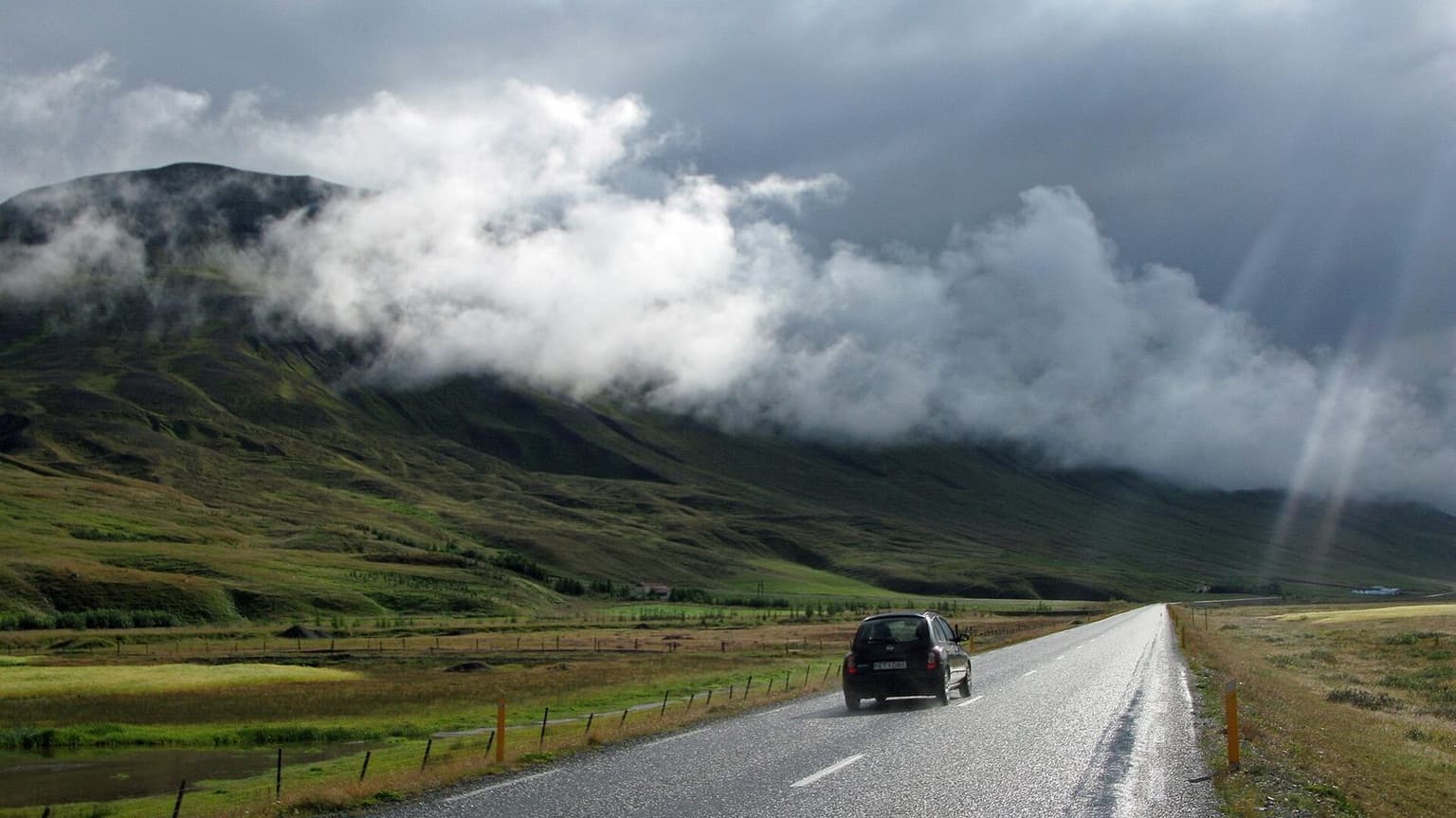
Volcanoes and lava
Volcano Express at Harpa: how long does it take?
The ride is about ten minutes and the interactive pre-show about thirty; the operator puts the whole visit at 15 to 45 minutes depending on how long you stay in the pre-show, and asks you to arrive 10 to 15 minutes early.
Volcano Express at Harpa: can children go?
From age four and 100 cm. Under-12s ride with an adult; the pre-show has no age limit. The operator does not advise the ride in pregnancy or for people with chronic pain, heart conditions or sensitivity to flashing light; static front seats are available.
Volcano Express at Harpa: is it accessible?
The operator states it is fully wheelchair accessible, and Harpa is step-free with lifts to level K2, where the show is.
Volcano Express at Harpa: do I need to book?
Not usually: tickets are sold on tix.is and at the desk in Harpa, with no booking fee, and shows start every 15 minutes.
Dimmuborgir lava-formation trails at Mývatn: how long are the trails?
Visit Mývatn gives the small circle as about 30 minutes and the big circle, which reaches the formation called the Church, as about an hour. Maps stand at each trail junction; most routes are easy.
Dimmuborgir lava-formation trails at Mývatn: is there a fee?
The Environment Agency's page lists no fee for the protected area. A parking charge is mentioned on third-party sites, but no official or operator page stating one could be read on 1 November 2026; read the sign.
Dimmuborgir lava-formation trails at Mývatn: can I bring a dog?
No, unless the supervisor grants a special permit. The protection rules also ban camping, leaving rubbish and damaging the formations or vegetation.
Dimmuborgir lava-formation trails at Mývatn: what happens at Christmas?
The Environment Agency's page says the area is busy in the run-up to Christmas, when the Yule Lads appear.
Fagradalsfjall eruption-site hike: is the eruption site open now?
On 1 November 2026 safetravel.is said there is no active eruption near Grindavík and that the old Fagradalsfjall site can be hiked from P1. Visit Reykjanes says the most recent eruption, at Sundhnúksgígar, ended on 5 August 2025. Check both on the morning, because access changes quickly if an eruption starts.
Fagradalsfjall eruption-site hike: which path should I take?
Visit Reykjanes lists Path A, 6–8 km each way and 2–2½ hours, to the 2021–2022 craters; Path C, about 4 km each way to a viewpoint over the 2021, 2022 and 2023 lava; Path E, 18–20 km return and 5–6 hours, to the 2023 Litli-Hrútur site; and short yellow paths of about 2 km each way to the 2021 lava edge.
Fagradalsfjall eruption-site hike: can I walk on the lava?
No. Safetravel.is says it is strictly forbidden, because the lava underneath may still be fresh, and Visit Reykjanes warns that the crust can break or cut. Stay on marked paths.
Fagradalsfjall eruption-site hike: what if the weather is bad?
Do not go. Visit Reykjanes has posted warnings against hiking to Fagradalsfjall during yellow weather warnings. A sheltered indoor option is under Alternatives.
Inside Þríhnúkagígur volcano: how hard is it?
The operator rates it 2 out of 5: a guided walk of about 3 km each way across a lava field, 45–50 minutes, ending with a climb of about 50 m to the crater. Hiking boots are recommended.
How long inside the volcano?
About 30 minutes on the floor of the chamber, after a lift descent of about seven minutes down 120 m. Lamb soup or a vegan option is served at base camp afterwards.
Inside Þríhnúkagígur volcano: can children go?
The child fare covers ages 8 to 12, so eight is the youngest age priced; the operator's page read today does not state a separate minimum age.
Inside Þríhnúkagígur volcano: is there a way in without walking?
The operator offers helicopter and private tours on request, priced by quote through info@insidethevolcano.com or +354 519 5609; the site lists no fixed fare for them.
Is it real lava?
The operator says it superheats real lava rock to about 1,100°C and pours it into the showroom; the rock used in its products comes from the 1918 Katla eruption. It also states that the lava does not give off harmful volcanic gases.
Lava Show in Reykjavík: Classic or Premium?
Classic is 45–55 minutes with ground-level seating closest to the flow. Premium, Reykjavík only and adults 13+, is 60 minutes with a drink, a lounge, balcony seats and a piece of lava to take home, for 9,990 ISK against 6,590.
Lava Show in Reykjavík: can babies come?
Yes, by the operator's FAQ: infants sit in the third row near an exit, and children 0–1 are free on a parent's lap. It warns the heat, noise and English commentary may overwhelm small children.
Lava Show in Reykjavík: how do I get there without a car?
Walk (the operator says about 27 minutes from Harpa), take Strætó routes 3 or 14, or the free Grandi shuttle the operator lists from central Reykjavík. There is free parking on site.
Raufarhólshellir lava tunnel: is it difficult?
The standard tour is rated 1 out of 5. The operator does not recommend it for people with balance problems or difficulty on uneven ground or steep stairs. Helmets and lights are provided; bring warm clothes and sturdy shoes, as water drips from the roof.
Raufarhólshellir lava tunnel: what is the minimum age?
Three for the standard tour (free from three to six), twelve for the Lava Falls Adventure, which takes three to four hours over large boulders and must be booked at least a day ahead.
Raufarhólshellir lava tunnel: can I go without a car?
Yes: the operator sells the standard tour with transport from Reykjavík for 14,900 ISK, about three hours in all.
Raufarhólshellir lava tunnel: is it open in winter?
Yes, every day, and the operator says the tunnel is easily reached in winter. Road 39 can still be icy; road.is shows its state that morning.
Vatnshellir lava cave on Snæfellsnes: what is in the cave?
A lava tube in the Purkhólar craters, roughly 8,000 years old, entered by a spiral staircase and walked with a torch; the lower section is the dark, cold part where the guide switches the lights off. The operator does not state the depth or length on the page read today.
Vatnshellir lava cave on Snæfellsnes: is it suitable for children?
From five. Under-fives are not admitted. Children five to eleven are free, teenagers 2,600 ISK. Helmets and torches are supplied; headlamps, high heels, flat-soled shoes and flip-flops are not allowed.
Vatnshellir lava cave on Snæfellsnes: do I need to book?
The page says departures every day and sends you to the booking system for times, with free cancellation up to four hours before. In July, book; otherwise walk up ten minutes before a departure.
Vatnshellir lava cave on Snæfellsnes: how does it fit the Snæfellsnes day?
The cave is on Route 574 between Arnarstapi and Hellnar and the Malarrif lighthouse, on the national park's south side. On the ten-day Ring Road's Borgarnes-to-Stykkishólmur day it is on the road; add about 85 minutes to that day and nothing to the driving.
Víðgelmir lava cave near Húsafell: is it hard?
The operator rates it 1 out of 5. A walkway with feature lighting runs through the cave; the temperature is low, so bring warm clothes, a hat and gloves. Helmet and headlight are provided.
Víðgelmir lava cave near Húsafell: can small children go?
Yes, with conditions: families with children under six must follow the cave's guidelines, which include staying at the back of the group and possibly turning round before the final stop.
Víðgelmir lava cave near Húsafell: how big is it?
The operator gives the volume as about 148,000 cubic metres and the lava formations as around 1,100 years old.
Víðgelmir lava cave near Húsafell: how does it fit with Into the Glacier?
Into the Glacier's page suggests the 15:00 cave after a 10:00 glacier tour, or a 12:00 cave before a 15:00 glacier tour. The service house is about 12 minutes' drive from Húsafell.
Glaciers and ice caves
Ásbyrgi canyon walks in Jökulsárgljúfur: which walk should I pick with an hour?
Botnstjörn (Á1), 1 km and about 30 minutes to the pond at the foot of the cliffs, which the park marks as suitable for limited mobility. With longer, Underneath Eyjan (Á4) is 3.5 km and 1–1.5 hours.
Ásbyrgi canyon walks in Jökulsárgljúfur: is the Eyjan walk safe?
The park rates Á2 Eyjan as easy, 4.5 km and 1.5–2 hours, but flags high cliffs on its listing; the walls reach about 100 m at the innermost part. Keep away from the edge, and more so in wind or ice.
Ásbyrgi canyon walks in Jökulsárgljúfur: is the visitor centre open in winter?
Yes, on weekdays. Gljúfrastofa's own page gives 11:00–15:00 Monday to Friday from 1 November to 20 December; the park's area notice says 10:00–15:00. Its toilets are open only during opening hours.
Can I walk from Ásbyrgi to Dettifoss?
The park's canyon trail is 32 km over about two days, rated challenging, with no huts; camping only at the Vesturdalur and Dettifoss campsites.
Is the boat worth it when the shore is free?
The shore gives you the icebergs at a distance and the bridge channel where they drift out to sea. The boat gives you 20 minutes among them and a guide. If the day is tight, walk the shore and the beach and skip the boat; if you are sleeping in Höfn and the forecast is calm, the first amphibian departure is the cheapest hour on the water on the whole south coast.
How often do the boats go?
The operator says at least every 30 minutes with four amphibian boats in June, July and August, and about ten Zodiac departures a day in high season. Outside those months check the booking calendar.
Boat on Jökulsárlón glacier lagoon: can children go?
The amphibian is listed as suitable for all ages, with under-sixes free. The Zodiac has no stated minimum age but a 130 cm minimum height, and its child fare starts at age 10.
Boat on Jökulsárlón glacier lagoon: what if the weather cancels it?
The terms say tours may be delayed or cancelled for weather or ice conditions on the lagoon, with a full refund. Date changes are free by e-mail.
Diamond Beach (Fellsfjara) at sunrise: is there always ice on the beach?
No. The ice comes out of Jökulsárlón through the river channel and washes back up on the sand; how much lies there depends on the lagoon and the sea. No source can promise it on a given morning.
Diamond Beach (Fellsfjara) at sunrise: what does it cost?
The beach is free. Parking in the Jökulsárlón area carries the national park's regional fee, 1,110 ISK for a car of up to five seats, valid until midnight on the day paid and halved if you have already paid at another fee area that day.
Diamond Beach (Fellsfjara) at sunrise: is it safe?
Treat the surf line with respect: do not stand among stranded blocks at the water's edge, and never climb on ice. The national park's rangers supervise the area every day of the year.
Diamond Beach (Fellsfjara) at sunrise: when is sunrise on my date?
Use the table on this page, computed for the beach. Iceland stays on UTC all year, so the times need no adjustment for summer time.
Which outlet glacier do you walk on?
The operator's page does not name it for the three-hour walk; the walks from Skaftafell Base use the outlets east of the visitor centre, reached by a short ride in a highland vehicle included in the price. Ask at booking if it matters to you.
Glacier hike from Skaftafell: Minimum age and footwear?
Ten years, and a minimum shoe size of EU 34, both from the tour page. Boots and rain gear are not included and can be rented.
Can I walk on the glacier on my own?
No. Safetravel.is says you should never go on a glacier without experience or the proper equipment and that crevasses can appear with limited warning signs; the park adds that outside summer conditions change rapidly. The tongues are guided-only in practice.
Glacier hike from Skaftafell: is Skaftafell or Sólheimajökull the better choice?
Skaftafell if you are sleeping east of Vík and want the shorter three-hour product; Sólheimajökull if the glacier walk has to happen on the drive out from Reykjavík. The ice is cleaner at Skaftafell and the walk-in shorter.
Glacier walk on Sólheimajökull: can I walk onto Sólheimajökull without a guide?
No. The ice edge is a few hundred metres from the car park and people do wander onto it, but safetravel.is says you should never go on a glacier without experience or the proper equipment, and both operators here supply crampons, harness, helmet and ice axe for a reason.
Glacier walk on Sólheimajökull: what is the minimum age?
Eight on the Troll Expeditions four-hour hike and ten on the Icelandic Mountain Guides hike with ice-cave visit, both read today. Children also need boots that take a crampon; the operators rent them.
Glacier walk on Sólheimajökull: does the price include boots and rain gear?
No. Both pages list hiking boots, rain gear and warm clothing as not included, with boots available to rent. Glacier gear (crampons, harness, helmet, ice axe) is included.
Glacier walk on Sólheimajökull: is there a refund if the weather cancels it?
Troll Expeditions refunds in full minus a 3 per cent card fee for cancellations made more than 24 hours ahead, and nothing within 24 hours; Icelandic Mountain Guides says change or cancel 24 hours before departure by e-mail. Operator cancellations are handled under the same terms pages; read them before you pay.
Into the Glacier ice tunnel on Langjökull: is it a natural ice cave?
No. It is a tunnel cut into the ice cap, which is why it runs all year. The operator says the temperature inside is around 0°C regardless of season and that its appearance can change with ongoing work.
Into the Glacier ice tunnel on Langjökull: can children go?
The operator says the Classic tour has no age restriction; the walk inside is about an hour on uneven, slippery ice with crampons provided, and the truck ride is bumpy. For children up to two it recommends a baby carrier.
Into the Glacier ice tunnel on Langjökull: can I drive to the tunnel?
No. It is high on the ice cap and reached only in the operator's modified trucks. In summer a 4x4 can reach Klaki base camp at the glacier edge; everyone else meets at Húsafell.
Into the Glacier ice tunnel on Langjökull: what is the refund policy?
For day tours: full refund with more than 24 hours' notice, no refund inside 24 hours. The operator may change or cancel the tour for weather or road conditions.
Katla ice cave from Vík: is this a real ice cave in winter only, like the Vatnajökull ones?
The operator lists it as year-round. It is a cave in the Kötlujökull outlet of Mýrdalsjökull with ash layers in the ice; the shape and the entrance change through the year, and in summer the roof is thinner. The Vatnajökull blue caves are a November-to-March product.
Katla ice cave from Vík: how much walking is there?
About 45 to 60 minutes in a super-jeep from Vík to the glacier area, then roughly a kilometre on foot to the cave and 45 to 60 minutes at and in it, per the tour page. Crampons, helmet and headlamp are supplied; waterproof boots and rain gear are not and can be rented.
Katla ice cave from Vík: Minimum age?
Six, on the page read today.
What happens with Katla itself?
Katla is a monitored volcano and the Civil Protection evacuation signs along Route 1 are real. The tours run under the glacier's edge, and the operator, not you, decides whether a day is safe; if sirens sound while you are in Vík, follow the signs out of the sandur.
Natural ice cave in Vatnajökull from Jökulsárlón: can I visit an ice cave without a tour?
No. Glacier Guides says that for safety it is not recommended to enter ice caves without a certified glacier guide, and Vatnajökull National Park's rangers at Breiðamerkursandur are responsible for the caves in Breiðamerkurjökull. Caves change, collapse and vanish between seasons.
Natural ice cave in Vatnajökull from Jökulsárlón: how old must children be?
It depends on the operator: 6 at Glacier Guides, 8 at Fjallsárlón (younger on a private tour by arrangement), and 10 at Local Guide, all read on 1 November 2026.
Natural ice cave in Vatnajökull from Jökulsárlón: what do I wear?
Warm layers, waterproof outer clothes, hat and gloves, and sturdy hiking boots with ankle support. The operators provide helmets and crampons or microspikes; Local Guide rents boots on site for a fee and says jeans and trainers are not suitable.
Natural ice cave in Vatnajökull from Jökulsárlón: will I have the cave to myself?
Unlikely. Glacier Guides says the same cave is used by several operators, and Local Guide says to expect other groups and possibly a wait, especially at Christmas and Easter.
Snowmobile on Langjökull from Gullfoss: do I need a licence?
To drive, yes: a valid driving licence, and the operator's FAQ sets 18 as the minimum age to operate a snowmobile. Passengers ride on the back; children from six may ride as passengers, one child per adult.
How long on the snowmobile?
One hour including stops. The rest of the four hours is the transfer from Gullfoss to the glacier base, 40 to 60 minutes each way in a modified truck, and kitting up.
Snowmobile on Langjökull from Gullfoss: what if the tour is late or long?
The operator's FAQ: a departure delayed by about 30 minutes can be cancelled for a full refund; a tour extended by two hours or more earns 25 per cent back, three hours or more 50 per cent.
Snowmobile on Langjökull from Gullfoss: can I go if pregnant?
The operator strongly advises against it, because base camp is far from the nearest hospital, and does not recommend the truck ride for people with back injuries.
Zodiac boat on Fjallsárlón glacier lagoon: how is it different from the Jökulsárlón boats?
Fjallsárlón is a smaller lagoon ten minutes west. The operator runs Zodiacs of up to 12 passengers that go as close as is safe to the glacier wall; its season runs from April to November.
Zodiac boat on Fjallsárlón glacier lagoon: can children go?
From five. The operator suggests parents with younger children take separate departures, one waiting in the FROST restaurant.
Zodiac boat on Fjallsárlón glacier lagoon: is it accessible?
There is a walk of about 10 minutes on gravel from reception to the boats; people with walking difficulties may need help.
Zodiac boat on Fjallsárlón glacier lagoon: what should I wear?
Dress for the weather: the boats are open. A thick flotation jacket and life vest are provided.
Can I walk on the ice sheet without a tour?
The ice-sheet track is a vehicle tour, not a public road (Kangerlussuaq stop page), and Visit Greenland says most excursions from Kangerlussuaq go by some form of road transport arranged locally. Walking on the ice without a guide is a safety decision this site will not recommend.
Walk on the ice sheet at Point 660 from Kangerlussuaq: what does it cost?
From DKK 735 for an adult aged 11 or over, on the local operator Albatros Arctic Circle's own Point 660 page, read 1 November 2026, bookable as a single tour; the operator says some tours have a child price. Greenland by Topas lists the same 5-hour walk at the same DKK 735 inside its packages.
Walk on the ice sheet at Point 660 from Kangerlussuaq: how difficult is it?
The seller grades the Point 660 walk 2 out of 5. A full-day walk on the ice with crampons and lunch is graded 3; an overnight in a tent on the ice cap 4.
How does it compare with an Icelandic glacier walk?
The Sólheimajökull walk on this site costs a South Coast day 340 minutes from USD 120: an outlet glacier with a guide and crampons. Point 660 is the edge of the ice sheet itself and costs a Kangerlussuaq day 330 minutes, but only after a flight to Greenland.
Lagoons and hot springs
A morning at a Reykjavík municipal pool: which pool?
Laugardalslaug is the big one with the 50 m outdoor pool and the most hot pots, by the campsite and the hostel; Vesturbæjarlaug is the small neighbourhood one west of the centre; Sundhöllin is the 1937 indoor hall with an outdoor deck, five minutes' walk from Hallgrímskirkja. All three cost the same.
A morning at a Reykjavík municipal pool: what are the rules?
Wash without a swimsuit before you enter, every time; the attendants enforce it. Shoes stay in the entrance area. Phones out of the changing rooms. Children under ten are free but must be with an adult.
A morning at a Reykjavík municipal pool: is there a card worth buying?
The 10-visit adult card is 7,000 ISK on the list read today, 700 a visit against 1,500 single, valid four years and not for groups. It pays from the fifth visit; a week with a pool each morning gets there.
A morning at a Reykjavík municipal pool: do I need a towel?
Bring one. Hire is 860 ISK, swimwear 1,270, and the entry-plus-both bundle is 2,770, which is almost double the bare entry.
Blue Lagoon between the airport and town: what does it cost?
Comfort from 11,990 ISK, Premium from 14,990 ISK and Signature from 18,490 ISK on the operator's prices page read on 1 November 2026, each a 'price from' that moves with the date and time slot. The slot you pick on bluelagoon.com sets the real figure; date it in your ledger.
Blue Lagoon between the airport and town: is it safe with the eruptions?
The lagoon sits in the Svartsengi area that has erupted repeatedly since 2023 and it has been evacuated and closed several times. It reopens when the Civil Protection allows. safetravel.is carries the current status each morning; keep the airport plan independent of it.
Blue Lagoon between the airport and town: can I store luggage?
Yes. The operator's parking guide (read 1 November 2026) says secure luggage storage sits near the car park 'for a small fee'; it does not publish the amount, so expect to pay at the counter. Parking itself is free.
Blue Lagoon between the airport and town: is there a cheaper way to do the same thing?
Yes. The municipal pools in Reykjanesbær, 15 minutes from the terminal, and in Reykjavík cost a fraction and need no booking; Sky Lagoon in Kópavogur is the other pre-booked, higher-priced option on the Reykjavík side.
Earth Lagoon at Mývatn (Jarðböðin): is this the same place as Mývatn Nature Baths?
Yes. The old domain redirects to earthlagoon.is and the site says 'Formerly Mývatn Nature Baths'. The Icelandic name, Jarðböðin við Mývatn, is unchanged.
Earth Lagoon at Mývatn (Jarðböðin): why two 'from' prices?
The homepage read today shows 'from 7,400 ISK' in one block and 'from 7,900 ISK' in another, and the Essential price page shows 7,900. The site does not explain the difference; assume 7,900 unless the booking calendar shows less.
Earth Lagoon at Mývatn (Jarðböðin): what is the renovation line on the site about?
The pricing page carries a notice that the new facility 'is scheduled to open in the summer of 2026'. The page was still carrying it on 1 November 2026; the baths are open on the hours above.
Earth Lagoon at Mývatn (Jarðböðin): Children?
Free up to five with an adult, 2,500 ISK from six to twelve, 3,900 ISK from thirteen to fifteen. The water is warm and shallow at the edges; the sulphur smell is the thing small children notice.
Fontana baths and rye-bread tour at Laugarvatn: what is the bread tour?
Rye bread baked in the hot ground by the lake and dug up in front of you, with tasting. In winter (1 October–31 May) the operator's hours page lists tours at 11:45 and 14:30; its FAQ also mentions a 10:15 start. Check the time when booking.
Fontana baths and rye-bread tour at Laugarvatn: do I need to book?
The operator recommends it, but walk-ins are accepted while there is space. The bread tour is often sold out, so book that and plan the baths around it.
Fontana baths and rye-bread tour at Laugarvatn: what does it cost for a family?
Two adults and two children aged 6–15 is 2 × 7,490 + 2 × 4,990 = 24,960 ISK for the baths at today's prices; under-sixes are free.
What if Fontana closes suddenly?
The operator says guests can reschedule or take a full refund. Cancellations inside the 24-hour (baths) or 48-hour (bread) windows are charged in full.
Forest Lagoon across the fjord from Akureyri: can children go in the evening?
The operator says all children are welcome until 20:00, but its price list gives 18:30 as the last entry for ages 0–12. Under-16s need a guardian of 18 or over, and after 22:00 under-18s must be with a parent, step-parent, grandparent or spouse.
Forest Lagoon across the fjord from Akureyri: can I get a refund?
Tickets cancelled more than 24 hours ahead can be moved to another date or refunded as a gift card. Otherwise the operator considers special cases by e-mail.
Forest Lagoon across the fjord from Akureyri: how long should I stay?
There is no strict limit; the operator recommends no longer than two hours.
Forest Lagoon across the fjord from Akureyri: do I need cash?
The operator says it only accepts Icelandic currency at the lagoon, so do not count on paying in euros or dollars.
GeoSea sea baths at Húsavík: which price is right?
On 1 November 2026 the operator's price page showed 7,490 ISK for an adult in Icelandic and 6,490 ISK in English. The gift voucher for one is 7,490, so the higher figure is probably current; check at booking.
GeoSea sea baths at Húsavík: what is the water?
Geothermally heated seawater, which the operator says was found when drilling for hot water and proved too rich in minerals for heating houses.
GeoSea sea baths at Húsavík: when can I bathe late?
Only in summer, June to August, when the baths stay open until midnight and you can stay in until 23:45. In winter the doors close at 22:00.
GeoSea sea baths at Húsavík: do I need to bring a towel?
You can rent one: towel 1,590 ISK, swimsuit 1,290, bathrobe 2,790 on the Icelandic list read today.
Hofsós swimming pool on Skagafjörður: what does it cost?
On Skagafjörður's price list, read 1 November 2026: adult 1,400 ISK, children aged 7–18 from outside Skagafjörður 425 ISK, under-sevens free, seniors and disabled 425 ISK. Swimsuit and towel hire are 850 ISK each.
Hofsós swimming pool on Skagafjörður: when is it open in winter?
The municipality's pools page did not publish opening hours on 1 November 2026, and third-party listings disagree. Phone the pool on +354 455 6070 or check its Facebook page before driving out.
Hofsós swimming pool on Skagafjörður: who runs it?
The municipality of Skagafjörður, which also runs the pools in Sauðárkrókur and Varmahlíð and leases the one at Sólgarðar in Fljót.
Hvammsvík hot springs in Hvalfjörður: can children go?
From ten. Under-18s need a guardian of 18 or over, and the operator charges everyone over the minimum age the same price: there are no child or senior discounts, only different packages.
Hvammsvík hot springs in Hvalfjörður: what is in the packages?
Natural, Classic and Comfort differ in changing rooms, lockers, towels and drinks; all include the eight hot springs, the geothermal sauna and the shore area, by the operator's FAQ.
Hvammsvík hot springs in Hvalfjörður: can I swim in the sea?
You can take a cold plunge, but the operator warns that the sea level changes with the tides and can become deep unpredictably; take great care.
Hvammsvík hot springs in Hvalfjörður: is there a bus?
Yes: the booking page lists a package with transfer from the BSÍ terminal in Reykjavík at 10:00, from 14,999 ISK including entry.
Krauma baths at Deildartunguhver: where does the water come from?
From Deildartunguhver beside the baths, which Krauma describes as Europe's most powerful hot spring, at about 180 litres of 100°C water a second. The operator says it is cooled through heat exchangers and no chemicals are added.
Krauma baths at Deildartunguhver: what do children pay?
500 ISK for ages 0 to 12 and 4,160 ISK for 13 to 16, by today's price list. That makes it one of the cheaper family soaks in the West.
Krauma baths at Deildartunguhver: how long should I stay?
Krauma does not publish a suggested stay. This page allows 90 minutes, enough for the pools, the cold tub and the relaxation room with its fire.
Krauma baths at Deildartunguhver: is there food?
Yes, a restaurant open the same hours as the baths, with light meals; tables can be booked online.
Reykjadalur hot river walk above Hveragerði: how long is the walk?
No official page gives a distance. Visit Iceland, the national tourist board, calls it roughly an hour's hike up the valley and a three-hour outing in all. Routing on OpenStreetMap gives 7.2 km each way from the café car park to the mapped valley point, which probably overstates the walk to the main bathing section. Allow at least three hours.
Reykjadalur hot river walk above Hveragerði: is it ever closed?
Yes. Visit South Iceland says the trail can be closed and that safetravel.is shows whether the valley is open. Closures protect the ground after wet weather and during thaw.
Reykjadalur hot river walk above Hveragerði: is there a changing room?
The official page mentions no changing building in the valley. Come in layers you can change out of quickly, carry a dry set in a bag, and take everything home with you.
Reykjadalur hot river walk above Hveragerði: is it safe?
The ground is geothermal. Stay on the paths, as the regional office asks, and do not test pools away from the marked bathing stretch: some springs in the valley are boiling.
Secret Lagoon (Gamla laugin) at Flúðir: how long can I stay?
Individual guests have no fixed time limit; closing time is the limit. The operator gives the average stay as 1.5 to 2 hours.
Secret Lagoon (Gamla laugin) at Flúðir: what do children pay?
A token fee for 14 and under: 260 ISK on the price list, 200 ISK in the FAQ, read on the same day. Children 16 and under must be with an adult, and one adult can bring at most three children.
Secret Lagoon (Gamla laugin) at Flúðir: can I see the northern lights there?
Rarely: the operator notes that in the aurora season it closes in the evening, while chances are better later at night. Entering outside opening hours is forbidden and reported to the police.
Secret Lagoon (Gamla laugin) at Flúðir: is there a bus?
The operator links to daily tours from Reykjavík on its site; check what the tour includes and how long it allows at the pool.
Sky Lagoon in Kópavogur: is there an age limit?
Yes. Under-12s are not admitted; ages 12 to 14 must be with a guardian of 18 or over, and staff may ask for ID to confirm a child's date of birth.
Sky Lagoon in Kópavogur: how long can I stay?
The operator recommends 1.5 to 2 hours and asks guests to leave the lagoon 30 minutes before closing; the ritual and Gelmir bar close an hour before.
Sky Lagoon in Kópavogur: how warm and deep is it?
The operator gives 38–40°C and a maximum depth of 120 cm.
Sky Lagoon in Kópavogur: how do I get there from Keflavík?
The operator suggests the Flybus to Hamraborg, then a walk of about 30 minutes, bus 35 or 36, a scooter or a five-minute taxi.
Vök Baths on Lake Urriðavatn: how warm is the water?
The operator gives a range from 5°C to 41°C across a main pool, two floating pools, a cold plunge and the lake itself.
Vök Baths on Lake Urriðavatn: when is the last entry?
45 minutes before closing; guests leave the pools 15 minutes before. In winter that is 21:15 last entry and out of the water at 21:45.
Vök Baths on Lake Urriðavatn: can children go alone?
No. The minimum age to enter alone is 16; under-16s must be with parents. Children up to five are free.
Vök Baths on Lake Urriðavatn: is the bistro open every day?
Not in winter: from 1 October to 14 June it opens Friday to Sunday, 12:00 to 21:00; daily in summer.
Swimming at Copenhagen's harbour baths: is it really free?
Yes. The municipality's page for Islands Brygge states free access, and the three harbour baths — Islands Brygge, Fisketorvet and Sluseholmen — are run by Københavns Kommune's swimming service.
Swimming at Copenhagen's harbour baths: is the water clean?
The municipality publishes a daily bathing-water forecast with a three-day outlook, linked from each bath's page. Its own rule: do not swim if you cannot see your feet when standing knee-deep, even under a green signal, because of possible toxic algae.
Swimming at Copenhagen's harbour baths: can I swim anywhere in the harbour?
No. Københavns Kommune states that swimming in the harbour outside the designated bathing places is forbidden. Use the harbour baths or the marked bathing zones.
Swimming at Copenhagen's harbour baths: how deep is it?
At Islands Brygge the 75 × 8 m lap pool is 3 m deep, the diving pool 5 m, the play pool 1.2 m and the toddler pool 0.1–0.7 m, the municipality's page says. Diving platforms are at 1, 3 and 5 m.
Whales, puffins and horses
Dog sledding near Reykjavík: will there be snow?
Not guaranteed. The year-round option runs on a sled if there is snow or ice and on a wheeled kart if not, rather than being cancelled. The sled-only option (1 December to 15 April) is cancelled and refunded, minus 3,000 ISK per person, if sledding is impossible (read 2026-11-01).
Dog sledding near Reykjavík: who can ride?
From age 6, or 4 from May to September; under-18s with a parent or guardian on the ride. Not during pregnancy. Riders must be physically fit, at most 95 kg and with a BMI below 30, by the operator's terms.
Dog sledding near Reykjavík: do I drive the sled?
When the tour runs on a sled, the operator offers each participant a turn riding at the back with the musher guide.
Dog sledding near Reykjavík: what should I wear?
Long under-layers, a warm sweater, a waterproof jacket and trousers, waterproof boots above the ankle, gloves, hat and sunglasses or goggles. Insulated or rain suits can be lent. The operator advises against fur and white clothing.
Icelandic horse ride in the lava fields near Reykjavík: do I need to have ridden before?
No. The operator says the Lava Tour suits beginners and intermediate riders and splits the group: a relaxed group mostly at walk, and a faster group at trot and tölt for those who want it.
Icelandic horse ride in the lava fields near Reykjavík: are there age or weight limits?
Minimum age seven; children under 12 are advised to stay in the slower group unless used to riding. Maximum rider weight 110 kg on all tours.
Icelandic horse ride in the lava fields near Reykjavík: can I bring my own riding gear?
Only if cleaned: Iceland bans used leather riding gear and gloves from entry, and clothing must be washed or disinfected first, because Icelandic horses are unvaccinated. The operator lends helmets, boots and rainwear.
Icelandic horse ride in the lava fields near Reykjavík: is there anything after the ride?
Coffee, tea and hot chocolate at the stables, included.
When are the puffins there?
The operator runs the Classic puffin tour from 20 April to 20 August and the Premium RIB tour from 20 April to 15 August. Outside those dates there is no puffin boat.
Puffin boat from Reykjavík's Old Harbour: where does the boat go?
To one of three islands just outside the city where the birds are known to nest, by the operator's description. Which island depends on the day.
Puffin boat from Reykjavík's Old Harbour: can children go?
Yes: under-sevens are free on the Classic tour and ages 7–15 pay half. The Premium RIB takes children from ten at the adult price.
Will I see puffins on the whale tour instead?
Possibly, between May and August, flying or on the water, according to the operator; the Classic whale tour does not stop at the colonies, while the Premium whale tour does in summer.
When are the puffins there?
The village's site gives mid-April to mid-August, with the most birds from May to mid-August, after which they leave for the open sea. Visit Austurland says mid-April to the beginning of August. On 1 November there are none.
Puffins at Hafnarhólmi, Borgarfjörður eystri: how close do you get?
Close: the village's site describes a shelter and wooden platforms that let visitors get near the burrows without the risk of stepping into one or falling from a cliff.
Puffins at Hafnarhólmi, Borgarfjörður eystri: is there a fee?
None is listed on borgarfjordureystri.is or on Visit Austurland's page, read 1 November 2026. The Hafnarhús building beside the islet has a paid café and art exhibitions.
Puffins at Hafnarhólmi, Borgarfjörður eystri: what else nests there?
Kittiwakes, fulmars and common eiders, by both pages. All species are protected by law during the breeding season, the village's site says.
Puffins at Látrabjarg: how close can I get?
Closer than anywhere else in Iceland, because the birds nest in the turf at the top and have no fear of people. That is the hazard: the edge is undercut and the turf is riddled with burrows that give way. Stay back from the lip, lie down to look over, and never step on the burrowed ground.
When exactly are the puffins there?
The official pages read today give no dates; the reserve's own nesting-season rule runs 1 April to 31 August, and the puffins occupy the middle of it, roughly late May to mid-August by the stop page's wording. By September the ledges are empty.
Puffins at Látrabjarg: is the road bad?
Route 612 from the Patreksfjörður road is gravel to the lighthouse and the reserve's access page says it is not serviced in winter and can close in snow. In summer a 2wd manages it slowly; count an hour and more from the town.
Puffins at Látrabjarg: are there rangers?
The reserve's rules let rangers or the site manager close paths temporarily; the English page names Náttúruverndarstofnun for the ranger service. There is no visitor centre at the cliff.
How likely are whales?
The operator's page claims an average sighting rate above 97 per cent across three decades. It does not state what happens on the day you are in the 3 per cent; ask about a re-sail or refund before you pay.
Whale watching from Húsavík: which boat?
The Original tour sails on restored wooden boats; the same operator sells a quieter electric-and-sail version and a whales-and-puffins combination in the puffin months. Other companies on the quay run similar three-hour sailings on their own boats; none is compared here.
Whale watching from Húsavík: is it cold?
Yes, even in July. Overalls are supplied on most boats; bring a hat and gloves regardless. The bay is sheltered compared with the open sea but a northerly wind comes straight down it.
Whale watching from Húsavík: does this fit a Ring Road day?
Only with a Húsavík night or a long Mývatn day. The harbour is about 55 km from Reykjahlíð and 90 km from Akureyri on route 85, and the three hours of sailing plus the drive is most of a short day.
What if we see no whales?
Elding does not refund, but gives a free ticket to try again on a future Classic tour, valid for at least two years, for the same passengers and the same service. It advises booking early in the trip for that reason.
Whale watching from Reykjavík's Old Harbour: what do we usually see?
The operator lists humpback whales, minke whales, dolphins and porpoises as the most common, with seabirds all year and puffins from May to August.
Whale watching from Reykjavík's Old Harbour: what happens if the weather is bad?
Tours can be cancelled for unfavourable conditions, sometimes as late as two hours before departure; the operator contacts you to rebook or refund.
Whale watching from Reykjavík's Old Harbour: Classic or Premium?
Classic is the big boat: up to 196 passengers, a heated saloon, café and toilets, about three hours. Premium is a 12-seat RIB for two hours, April to October, with a puffin-colony stop in summer, at 24,900 ISK.
Dog sledding from Tromsø on Kvaløya: Guided ride or self-drive?
Same price, NOK 3,390 for an adult (operator page, 1 November 2026). On the guided Husky Sled Ride a guide drives and children from three can come at NOK 1,695. Self-drive is two to a sled, one driving and one riding, swapping halfway; it is 16 and over, not in pregnancy, and the operator asks for the fitness to jog uphill in snow and balance on one foot.
Dog sledding from Tromsø on Kvaløya: what is included?
About 45 minutes on the sled, the transfer (25–35 minutes each way), a guided walk through the dog yard and a puppy visit, a hot lunch in a turf hut (reindeer stew, chocolate cake, coffee) and a thermal suit and boots. Bring gloves and a hat; sunglasses from February.
Dog sledding from Tromsø on Kvaløya: where does it start?
In front of the Radisson Blu hotel in central Tromsø, 15 minutes before departure. The kennel is on Kvaløya, the island west of the city; you do not drive there yourself.
Dog sledding from Tromsø on Kvaløya: is there anything like it in Iceland?
Not on this site's Iceland pages. The nearest half-day on ice is the Sólheimajökull glacier walk, which costs a South Coast day 340 minutes. Sledding is the reason to choose Tromsø over Reykjavík for a winter week; the lights are not, because both cities chase them.
Husky ride from Rovaniemi: who drives the sled?
Adults, 17 and over, drive; the sled takes two adults and up to two children aged 4 to 11, and the adults swap halfway. Children under eight must be held by an adult. The guide decides the final seating.
Husky ride from Rovaniemi: can I drive to the kennel myself?
No. The operator does not allow it because the kennel is remote; drivers park free at the K-Market Sinettä and are picked up there. Pick-up is 15 to 90 minutes before the tour starts, depending on the point.
Husky ride from Rovaniemi: what if it is too cold?
The operator checks the Finnish Meteorological Institute forecast for Sinettä. At −28 to −30 °C it may shorten the tour without notice; at −30 to −35 °C self-driven tours may not run, and it contacts guests the day before. If it cancels for weather and cannot reschedule, it refunds 100 per cent.
Husky ride from Rovaniemi: Rovaniemi or Iceland for a winter half-day?
Iceland has no husky sledding on this site's pages; its winter half-days are on glaciers. Rovaniemi's case is the dogs, the forest and the Arctic Circle line on the road north of town; Iceland's is everything else.
Mykines for the puffins, by ferry from Sørvágur: what does the ferry cost?
The ferry is the public route 36 run by Strandfaraskip Landsins, and each direction is paid separately: DKK 153 for an adult at the quay, DKK 123 booked online; DKK 88 or DKK 70 online for a child or a senior (ssl.fo price list, read 1 November 2026). The crossing takes 45 minutes.
Mykines for the puffins, by ferry from Sørvágur: do I have to take a guide?
Yes, from 1 May to 31 August. Visit Faroe Islands says the fee, DKK 500 or DKK 400 booked online before arrival for anyone over 15, includes a mandatory guide who accompanies you on the island.
Mykines for the puffins, by ferry from Sørvágur: can I walk to the lighthouse?
Not at present. Visit Faroe Islands says the path to the lighthouse is closed after a landslide and that more landslides are possible; other parts of the island are open.
Mykines or Látrabjarg for puffins?
Látrabjarg in the Westfjords is free and on a road, but costs a Westfjords day 260 minutes on this site. Mykines costs a ferry, a fee and a whole day. If the trip is Iceland, go to Látrabjarg; if it is the Faroes, Mykines is the puffin day.
Will I see reindeer in summer?
Some. The operator's FAQ says most of the herd is up in the mountains in summer, so there are fewer reindeer at Jukkasjärvi and none at the lodge, but there are always some at the museum. In winter there are reindeer at the museum, the lodge and on the activities.
What happens on the winter reindeer outing?
Ráidu goes by snowmobile and sledge through the forest to the herd; you help feed them and try racing a reindeer sleigh on a 200 m track, then eat a traditional Sámi meal in a lávvu tent. About 4 hours, from age 3, with transfer, winter clothes, the meal and coffee included. No price was shown on 1 November 2026.
Are the reindeer safe to approach?
The operator says its reindeer are born wild and tamed, and remain wild animals: some may run, jump, strike with antlers or kick if they feel trapped. Follow the staff's instructions.
Reindeer and Sámi culture at Jukkasjärvi: how is this different from the Icehotel?
The Icehotel day visit on this site is an hour among ice rooms and art. This is an open-air museum about reindeer herding and life in Sápmi, in the same village; both fit one afternoon from Kiruna.
Vestmanna bird cliffs by boat: what does it cost?
DKK 450 for an adult and DKK 250 for a child aged 2 to 13, on the operator's booking form for its next listed sailing, read 1 November 2026. The descriptive pages carry no fare; the booking form does. A departure runs once 10 seats are sold.
Vestmanna bird cliffs by boat: what is the boat like?
A small passenger boat that goes close under the cliffs and, in calm water, into the sea caves and between the stacks; helmets are issued for the grottoes in past seasons. The operator says the tour is suitable for all ages and to dress for the weather.
Vestmanna bird cliffs by boat: what if the sea is up?
The operator's page says sea conditions can limit entry to the caves and access to the shore, and that it then offers an alternative tour to the south side of Vágar to see Trøllkonufingur. It does not describe a refund; ask when booking.
Vestmanna bird cliffs by boat: can I combine it with Saksun?
Yes; the ferry journey's day four does both, 135 km from Tórshavn and back. Saksun in the morning, the boat in the afternoon or evening, and the Vestmanna road home.
Northern lights
Northern lights night from Reykjavík: Boat or coach?
The boat is shorter, leaves from the Old Harbour on foot, has heated indoor seating and no minimum age; it cannot leave the bay, so cloud over the sea ends it. The coach goes where the forecast is clear, about an hour from town, and is 3 to 3.5 hours. On a night with a thin cloud gap the coach has the better odds.
Northern lights night from Reykjavík: what if there are no lights?
Both operators read today give a free retry: the boat operator a ticket to try again, valid indefinitely, and a bus substitute if the boat is cancelled on a good forecast; the coach operator a rebook ticket valid two years. If you leave Iceland without a second night, the boat operator offers a whale-watching exchange or a refund, per its page.
Northern lights night from Reykjavík: can I just drive out of town myself?
Yes, and it is free. Þingvellir, 45 minutes east, and the Reykjanes coast are the usual dark spots. The tour buys you a driver who reads the cloud map, which on a marginal night is the whole product.
Northern lights night from Reykjavík: what does the coach cost?
Not stated here, because the operator's pages loaded the fare by script and showed '0 ISK' and 'Loading…' when read today. Read it on re.is on the day and date it.
Aurora chase by minibus from Tromsø: what happens if there are no lights?
The operator offers 30 per cent off a second tour with it, which can be another aurora chase or a whale, fjord or fishing trip. It is a discount, not a free retry. On the off-peak adult fare that makes a second night NOK 1,231.
Aurora chase by minibus from Tromsø: what time does it leave?
At 18:30 from 21 September to 15 March, at 20:00 in early September and from 16 March, returning at 00:00 or 01:30. Meet 30 minutes earlier at Fr. Nansens plass 1, the main pier. Drop-off is at your hotel.
Aurora chase by minibus from Tromsø: is this better than chasing the lights from Reykjavík?
Neither city controls the cloud. Visit Tromsø places the city within the auroral zone, and its winter nights are longer; Reykjavík's boat on this site starts at 12,490 ISK and costs an evening 240 minutes, half this chase. Pick the city for the rest of the trip, not for the lights.
Aurora chase by minibus from Tromsø: do I need the minibus at all?
No. The Lapland journey's day six is a self-driven aurora night. The minibus earns its fare on nights when the clear sky is two hours away, and when the roads are icy.
Aurora Sky Station at Abisko: what does it cost?
On STF's booking pages, read 1 November 2026: the Night Visit from SEK 1,295 an adult, the Northern Light Dinner from SEK 2,395 an adult with drinks extra, and a daytime return on the chairlift from SEK 260. The station's own site prints no fares; drop-in Night Visit tickets are sold at the lift if any of the 40 places remain.
Aurora Sky Station at Abisko: what if the weather closes the lift?
The Night Visit moves to a wood-fired lavvu in the national park with guided walks to viewing spots, and the page says no refund is made if weather stops the lift. For the dinner, a storm programme called Aurora Lounge replaces the station, again without refund.
Aurora Sky Station at Abisko: is there an age limit?
Yes: STF's booking pages give a minimum age of 12 for the Night Visit and 16 for the Northern Light Dinner, in both cases with a guardian.
Aurora Sky Station at Abisko: Abisko or Reykjavík for the lights?
Abisko's case is its own published record and a bed beside the lift. Reykjavík's case is everything else on an Iceland trip. A single night at either is a coin toss; three nights at Abisko are the better bet on the operator's own numbers.
Waterfalls and walks
Behind Seljalandsfoss and into Gljúfrabúi: do I pay twice for the two falls?
No. Gljúfrabúi is a short walk north along the cliff from the Seljalandsfoss car park, so one day's parking covers both. The fee on checkit.is, read 1 November 2026, is 900 ISK for a car and runs until midnight.
Behind Seljalandsfoss and into Gljúfrabúi: will I get wet?
Yes, behind Seljalandsfoss the spray soaks anything that is not waterproof, and the way into Gljúfrabúi is along a stream bed between rock walls. Waterproof jacket and trousers and shoes that can take water are the kit.
Is the walk behind the falls open in winter?
No official page read on 1 November 2026 gives a closure period. The path is rock and gravel under constant spray, so it ices in frost; follow the signs at the falls on the day.
Behind Seljalandsfoss and into Gljúfrabúi: what if I do not pay?
Checkit uses number-plate reading. If the fee is not paid within 24 hours, a claim goes to the car owner's bank with a 100 ISK charge; a hire company may add its own fee.
Day hike at Landmannalaugar: Laugahraun loop: what is Laugahringur?
The name people use for the lava-field loop from the hut through Laugahraun and back below Brennisteinsalda. FÍ's page calls it 'Laugahraun og Brennisteinsalda': about 5 km and one to two hours, fairly easy, with about 3 km added if you climb Brennisteinsalda, where there is some ascent.
Day hike at Landmannalaugar: Laugahraun loop: how hard is Brennisteinsalda?
FÍ's trail page gives 7 km, 3.5 hours and 300 m of climb for the summit from the hut, on a well-marked path 'accessible to most'. Bláhnúkur, the other summit, is 'challenging in places' and about 10 km as a loop back through Laugahraun, 2–3 hours on the overview page.
Day hike at Landmannalaugar: Laugahraun loop: can I do it as a day trip from Reykjavík?
By bus, yes: Trex's Bus 1 leaves City Hall at 07:30, arrives 11:20 and leaves at 14:30, which gives 3 hours 10 minutes for the loop without the summit. Fare 31,800 ISK return. By car it is about two hours each way on F225 or F208 from Hella and a 4x4.
Day hike at Landmannalaugar: Laugahraun loop: do I need to book the car park?
Yes, between 09:00 and 16:00 from 20 June to 13 September, per parka.is; outside those hours the fee applies but no booking. The camera reads your plate, so the registration must be right.
Dettifoss to Selfoss loop from the west car park: West side or east side?
West. The park says road 862 on the west bank is paved, though with limited winter service; road 864 on the east bank is gravel, slow, and closes when snow starts in autumn until the mud dries in spring. The D2 loop to Selfoss starts from the west car park.
Dettifoss to Selfoss loop from the west car park: how hard is it?
The park rates the D2 loop easy: 2.5 km, about an hour. It is 1 km to Dettifoss, then along the riverbank to Selfoss and back by the more westerly path.
Dettifoss to Selfoss loop from the west car park: is there anywhere to stay or eat?
No overnight stays at Dettifoss, by the park's page; there is a car park and a WC. Food is at Reykjahlíð or Ásbyrgi.
Dettifoss to Selfoss loop from the west car park: how big are the falls?
The park gives Dettifoss as about 44–45 m high and about 100 m wide, and Selfoss as a drop of about 10 m above it.
Djúpalónssandur beach and the Dritvík path: can I try the lifting stones?
The Environment Agency says only that fishermen lifted large boulders on the beach to show off their strength; it publishes no names or weights. Lifting a heavy rock off the ground is a back injury waiting to happen. Leave them where they lie.
Djúpalónssandur beach and the Dritvík path: what is the wreck?
Rusted iron from a trawler wreck lies on the pebbles. The park's English pages, read on 1 November 2026, do not give the ship's history, so it is not repeated here. The pieces are part of the site; leave them in place.
Djúpalónssandur beach and the Dritvík path: are there toilets?
In summer at the Djúpalónssandur car park, by the park's FAQ. The toilets at the Malarrif visitor centre, a short drive east, are open 24 hours, all year.
Djúpalónssandur beach and the Dritvík path: is the beach safe for children?
On the path, yes; at the waterline, no. Safetravel describes sneaker waves running far beyond the ordinary surf on Iceland's open beaches. Hold small children's hands and keep well back.
Glymur waterfall hike in Hvalfjörður: how hard is it?
Visit West Iceland describes it as for those not daunted by heights or challenging hikes: about four hours return, through a rock arch, with a river crossing on a placed log, and paths along the gorge edge.
Glymur waterfall hike in Hvalfjörður: can I do it in winter?
The regional office warns that in winter the path can be dangerous and that proper equipment and hiking experience are essential. Without the summer log crossing, the river has to be waded.
Glymur waterfall hike in Hvalfjörður: how far from Reykjavík?
To the trailhead in Botnsdalur, 71 km and about 66 minutes by OSRM on OpenStreetMap, via road 47 round the fjord.
Glymur waterfall hike in Hvalfjörður: is it suitable for children?
The regional page sets no age limit but describes the walk as challenging and not for anyone daunted by heights; the path runs along the gorge edge, so only older children used to steep ground, with an adult beside them.
Hengifoss walk in Fljótsdalur: how hard is the walk?
Visit Austurland describes a good gravel trail of about 2 km, moderately steep but not very difficult, with stairs at the start. It takes 40 to 60 minutes up from the car park.
Hengifoss walk in Fljótsdalur: what is halfway?
Litlanesfoss, a 25–30 m waterfall framed by basalt columns, about 1.2 km from the car park.
Hengifoss walk in Fljótsdalur: is it safe with children?
On the trail, yes; at the edge, take care. The regional page warns that walking close to the canyon edge is risky because of the danger of falling, especially with children.
Hengifoss walk in Fljótsdalur: what if the car park is full?
The regional page suggests driving 5 km on to the Skriðuklaustur national park visitor centre and coming back when a space has opened.
Hraunfossar and Barnafoss walk: is it accessible?
In parts. The Environment Agency says there is good wheelchair access in parts of the Hraunfossar and Barnafoss area, with well-marked trails and clearly defined viewpoints.
Hraunfossar and Barnafoss walk: are there toilets?
Yes. The agency lists toilet facilities and an information sign on the main sites of interest.
Hraunfossar and Barnafoss walk: is it open in winter?
The agency says the area is accessible all year round. Paths around falls collect spray and ice in cold weather, so wear shoes with grip from November to April.
Hraunfossar and Barnafoss walk: how long is the walk?
The agency publishes no walking time. The marked loop from the car park to the Hraunfossar viewpoints and up to the Barnafoss bridge is short; 30 to 60 minutes covers it at an easy pace.
Hveradalir hike in Kerlingarfjöll: can a normal car get there?
The operator says that in summer Highland Base can be reached by car via road 35 and F347, and that in winter only its super-jeep transfers go in. Its Hveradalir page adds that driving the last 4 km from the base to the valley is for 4x4 vehicles. Check your hire contract for F-roads.
Hveradalir hike in Kerlingarfjöll: do I need the guide?
No. The operator lists self-guided trails with details at reception, and the guided hike is a daily 09:00 option from 20 June to 30 September at ISK 24,900 per guest (1 November 2026), age limit 12.
Hveradalir hike in Kerlingarfjöll: can I leave the trail for a photo?
No. The operator states that Hveradalir is in the Kerlingarfjöll protected area and that going beyond marked trails is prohibited and can be dangerous: the ground round the vents is hot and unstable.
Hveradalir hike in Kerlingarfjöll: how big is the area?
The nature agency gives the mountain group as about 140 km² and the protected landscape area, declared in summer 2020, as 367 km², with peaks above 1,400 m.
Can I climb Kirkjufell from here?
This page does not describe the climb. Visit Iceland, the national tourist board, calls it a steep, technical scramble with past fatal accidents, says it should only be tried by experienced mountaineers with a professional local guide, and strongly discourages it in winter.
Kirkjufell and Kirkjufellsfoss short walk: is there a fee?
Visit Iceland says there is a parking fee at the Kirkjufellsfoss lot and that the mountain itself is free to view. No page giving the amount or the operator could be read on 1 November 2026, so read the sign at the car park.
Kirkjufell and Kirkjufellsfoss short walk: are there toilets?
Visit Iceland says there are no restrooms or cafés at the mountain. Grundarfjörður's public toilets are at the harbour, Nesvegur 2, open 09:00–17:00 from 1 November to 31 March, at 300 ISK (grundarfjordur.is, read 2026-11-01).
Kirkjufell and Kirkjufellsfoss short walk: can I fly a drone?
Visit Iceland says drone use may be restricted in the area, especially in the bird nesting season. Check the signs on arrival.
Rafting the Hvítá below Gullfoss: how rough is it?
The seller grades the Hvítá trip Class II: simple rapids, regular small waves and wide channels, described as moderate. Every paddler must be able to swim.
Rafting the Hvítá below Gullfoss: what is the minimum age?
11, with a guardian. The seller's family trip in the West takes children from six; its East Iceland and multi-day trips are 18+.
Rafting the Hvítá below Gullfoss: how long on the water?
About 90 minutes of the three hours. The rest is kitting up in drysuits, the briefing, and the hot tubs and sauna at the base afterwards.
Rafting the Hvítá below Gullfoss: can I go without a car?
Yes: the seller runs an eight-hour version with pick-up from Reykjavík starting at 12:30.
Reykjanesviti lighthouse and Gunnuhver boardwalks: is it safe to go with the Reykjanes eruptions?
On 1 November 2026 safetravel.is said there is no active eruption in the Grindavík area and that Grindavík is open; Visit Reykjanes says the last eruption ended on 5 August 2025. The peninsula remains on a civil-protection uncertainty phase, so read safetravel.is on the day.
Reykjanesviti lighthouse and Gunnuhver boardwalks: can I go up the lighthouse?
The pages read today did not say the tower is open to visitors. The visitor centre beside it has a café, a display on lighthouses and their keepers, and an exhibition on shipwrecks in the old engine house.
Reykjanesviti lighthouse and Gunnuhver boardwalks: how far apart are the lighthouse and Gunnuhver?
The two car parks are about 1 km apart by road, by OSRM on OpenStreetMap, roughly two minutes' drive; on foot it is 990 m by OpenStreetMap foot routing, about 12 minutes at 80 m a minute.
Reykjanesviti lighthouse and Gunnuhver boardwalks: can I climb Valahnúkur?
Carefully, if at all. Visit Reykjanes says cracks have been visible on the tip of the cliff since 2016 and that access has been limited.
Reykjavík Food Walk from Harpa: who actually runs it?
The Reykjavik Food Walk, whose site gives Klapparstígur 25 and +354 454 0222. Wake Up Reykjavík lists the same walk at the same address and sells it at 18,900 ISK. reykjavikfoodwalk.com now redirects to thereykjavikfoodwalk.com.
Reykjavík Food Walk from Harpa: what if I am vegetarian or vegan?
The operator says vegetarian, pescatarian, gluten-free and lactose-free alternatives are easy, as is avoiding nuts, seeds, fruit and shellfish, if you say so when booking. Vegans are welcome, but the operator warns that traditional Icelandic food is hard to adapt.
Reykjavík Food Walk from Harpa: is it wheelchair accessible?
No. The operator states the walk is not wheelchair accessible because of the old buildings of the restaurants it visits.
Reykjavík Food Walk from Harpa: how big are the groups?
Open tours are capped at 12 to 14 guests, by the operator's FAQ. Private tours take groups of 1–20 online and larger groups by email.
Reynisfjara beach walk and its wave lights: what do the lights mean?
Safetravel, read 1 November 2026: yellow is moderate hazard, stay alert; orange is considerable hazard, keep at least 25 m from the sea; red is severe hazard, the beach is closed but the designated viewing area stays open.
Reynisfjara beach walk and its wave lights: can I go into the cave and along to the stacks?
Only when the light and the tide allow. Visit Iceland's safety article tells visitors to check the Vík tide tables so as not to be trapped in the cave or on the eastern end, and to stay away from the cliffs because of rockfall.
Reynisfjara beach walk and its wave lights: is there a lifeguard?
No. Visit Iceland's article states there are no lifeguards or manned safety measures, and Parka's page says people are on the beach at their own risk.
Reynisfjara beach walk and its wave lights: how long does the parking last?
Four hours per fee at Reynisfjara, by Parka's page read on 1 November 2026; the beach rarely needs more than one.
Seyðisfjörður's rainbow street and the Tvísöngur walk: how far is the walk?
Skaftfell says to walk up a gravel road for 15–20 minutes, starting across from the Brimberg fish factory. Allow the same down, and time inside the domes.
Seyðisfjörður's rainbow street and the Tvísöngur walk: what is Tvísöngur?
A concrete sculpture by the German artist Lukas Kühne, opened on 5 September 2012: five joined domes 2–4 m high over about 30 m², each resonating at one tone of the Icelandic five-tone harmony tradition.
Seyðisfjörður's rainbow street and the Tvísöngur walk: is Fjarðarheiði open in winter?
Not always; it is a mountain pass. Read umferdin.is, which road.is now redirects to, and vedur.is on the morning you drive, as safetravel.is advises.
Seyðisfjörður's rainbow street and the Tvísöngur walk: when was the street painted?
Visit Austurland says residents painted Norðurgata in rainbow colours one summer night in 2016 and repaint it every summer; the Blue Church stands at its end.
Skógafoss stairs and the first hour of Fimmvörðuháls: how far should I go?
The Iceland Touring Association gives Skógar to Baldvinsskáli as 12 km in 4–5 hours with about 1,000 m of ascent. An hour of that pace is roughly 2.5–3 km, which passes several of the upper falls on the Skógá. Turn round at the hour, whatever is round the next bend.
Skógafoss stairs and the first hour of Fimmvörðuháls: is the whole pass open?
Not as a casual walk. On 25 August 2026 the Icelandic Tourist Board relayed a warning from the touring clubs and the Hvolsvöllur rescue team against crossing between Baldvinsskáli and Fimmvörðuhálsskáli, where glacier retreat has opened ravines and crevasses.
Skógafoss stairs and the first hour of Fimmvörðuháls: do I need hiking boots?
For the stairs alone, no. Past the top the path is earth and gravel, muddy after rain; boots with grip and a waterproof layer are sensible.
Skógafoss stairs and the first hour of Fimmvörðuháls: how long can I park?
The Parka fee, read on 1 November 2026, covers five hours at a time. The walk fits inside one period.
Sólheimasandur DC-3 wreck: walk or shuttle: how far is the walk?
The shuttle operator gives 4 km from the car park to the wreck, and says walking takes nearly two hours there and back. The track is flat and exposed, with nothing between you and the weather.
Sólheimasandur DC-3 wreck: walk or shuttle: how does the shuttle work?
Icelandic Mountain Guides by Icelandia runs it from the Sólheimasandur car park, seven days a week from 10:00, last departure 17:00 depending on daylight. It takes 10–15 minutes each way; tickets were 3,400 ISK on 1 November 2026, online or on the bus.
Sólheimasandur DC-3 wreck: walk or shuttle: can I drive to the wreck?
No. Cars stay in the car park beside Route 1; the operator's page says vehicles are not allowed on the beach.
Sólheimasandur DC-3 wreck: walk or shuttle: what does parking cost?
Parka's page, read 1 November 2026: 750 ISK for a car of up to five seats and 1,000 ISK for six to eight, valid for the calendar day from midnight.
Stokksnes and Vestrahorn: the beach and dunes walk: how much is the fee, and where do I pay?
1,200 ISK per person and free for under-16s in the admission panel across vestrahorn.is on 1 November 2026, though older text on the site says 1,100 and 1,000 ISK. Pay at Viking Café, open 07:30–22:00, or at the self-service kiosk outside it overnight. Each ticket is valid once.
Stokksnes and Vestrahorn: the beach and dunes walk: do I need a 4x4?
No, by the landowner's site: the last 4 km are gravel but manageable in any car, unless there is heavy snow, when a 4x4 may be needed.
Stokksnes and Vestrahorn: the beach and dunes walk: which path is the dunes walk?
The yellow path, 5.5 km and rated easy, along the black-sand beach and past the Viking village film set. The red path is 5.1 km around Kirkjusandur and Drápsbjörg, slippery when wet; the blue path is 7.4 km and moderate.
Stokksnes and Vestrahorn: the beach and dunes walk: what is the Viking village?
A film set built in 2009, mostly of driftwood and old telephone poles, by the landowner's account. It is open all year and included in the ticket.
Stuðlagil canyon walk on the east bank: which side should I visit?
The west side (Grund) has viewing platforms a short walk from the car park. The east side, from Klaustursel, is the walk down to the river and the columns at eye level: about 10 km return from the bridge car park or about 5 km from the Stuðlafoss car park, by Visit Austurland's figures.
Stuðlagil canyon walk on the east bank: can I swim or wade?
No. Visit Austurland says entering Jökla or any glacial river is extremely dangerous and forbidden; safetravel.is says to stay out of the water always and not to walk on the riverbank.
Stuðlagil canyon walk on the east bank: why is the water colour different some days?
Jökla's level and colour depend on the Hálslón reservoir upstream. When it overflows, most commonly from the beginning of August until October by Visit Austurland's account, the river turns grey-brown.
Stuðlagil canyon walk on the east bank: is the road open in winter?
Visit Austurland says road 923 is gravel, passable by all cars and open all year, but that winter weather and road conditions change in minutes. road.is shows the current state of 923.
How far is the walk?
The agency gives a time rather than a distance: about 15 minutes up along the Dynjandisá from the car park to the big fall. The lowest section is paved and accessible as far as Hrísvaðsfoss; above that it is a natural path, rocky and uneven in places, with viewing platforms at two of the falls.
Walk to the top of Dynjandi: what does parking cost?
1,110 ISK for a car of up to five seats, 1,440 ISK for six to nine, under article 18 of the Nature Conservation Agency's fee schedule no. 290/2026, the single rate for its fee-paying car parks in protected areas outside Landmannalaugar and Dyrhólaey. Walking itself is free.
Walk to the top of Dynjandi: can I camp?
No. The access page says overnight stays are not permitted and that there is no waste collection; take everything away.
Walk to the top of Dynjandi: is it reachable in winter?
Route 60 through the Dýrafjörður tunnel keeps the area reachable from Ísafjörður in winter, but the path is iced and the Dynjandisheiði pass to the south closes in storms. The toilets are open all year, per the agency.
Þakgil canyon walk and campsite: can I drive there in a normal car?
The operator's page says the road into Þakgil is passable for all cars. It leaves Route 1 at Höfðabrekka, 5 km east of Vík, and follows the old line of Route 1, in use until 1955, for 14 km. The road is gravel, and road.is shows whether it is open on the day.
Þakgil canyon walk and campsite: where do the walks go?
The operator says there are many walks of all grades from the campsite, and publishes trail maps on its site. Times and distances are not stated there; ask on arrival.
Þakgil canyon walk and campsite: what is the cave?
The campsite's dining room is a natural cave fitted with tables, benches, a stove and a grill, by the operator's description.
Þakgil canyon walk and campsite: can I see Katla from there?
The site sits between Mýrdalsjökull and Mýrdalssandur. The operator links a RÚV webcam set up with the Civil Protection and Síminn to watch Katla.
Þórsmörk by highland bus for the day: why not drive?
The F249 crosses the Krossá and other glacial rivers without bridges, and a rental 2wd or a small 4x4 is uninsured and often stuck in them. The buses are built for the fords. safetravel.is treats these crossings as expert-only.
How long do I get in Þórsmörk?
On Bus 1 both ways: Langidalur 11:15 to 14:30, 195 minutes. Out on Bus 1 and back on Bus 2: 11:15 to 18:00, 405 minutes, in the weeks Bus 2 runs. Básar is 15 minutes earlier each way.
Þórsmörk by highland bus for the day: which stop?
Langidalur is the FÍ hut and the start of the Valahnúkur climb; Básar is the Útivist hut across the Krossá footbridge. The bus serves both; Volcano Huts at Húsadalur is not on the timetable read today.
Þórsmörk by highland bus for the day: what does the Reykjavík version cost?
15,900 ISK one way and 31,800 return, leaving City Hall at 07:30 and back at 18:15; children six to fifteen get 20 per cent off one-way tickets to or from Reykjavík when travelling with an adult.
Abisko National Park summer day hike: how far is it and how long does it take?
The national park says the Nissonjåhka camping site is five kilometres south of the main entrance along the Kungsleden, so out and back is 10 km. At the pace STF gives for the first full stage (15 km in 4–6 hours), that is 2 h 40 to 4 hours of walking.
Abisko National Park summer day hike: are there toilets and water?
Toilets are at Naturum Abisko, the STF tourist station and the camping service building; Nissonjåhka has a dry toilet (bring paper) and a rest area with benches. STF says water can be collected from streams along the trail.
Abisko National Park summer day hike: can I camp anywhere?
No. The national park allows camping only at the designated sites: at the main entrance (reception at the tourist station), at Nissonjåhka and at the Abiskojaure cabin site. There are no motorhome pitches, and no camping in the long-stay car park.
How do I get to Abisko without a car?
The national park says the Abisko Turist railway halt is about 800 m from the STF tourist station and Naturum, and the bus from Kiruna takes about 1 h 15. By car from Kiruna it is 94 km, about 80 minutes by OSRM.
Do I need a ticket to walk Bryggen?
No. The front, the passages between the rows and most of the yards are open to walk. The tickets are for the Hanseatic Museum and Schøtstuene, run by Museum Vest, and for Bryggens Museum, run by Bymuseet i Bergen.
Bryggen walk in Bergen: is the Hanseatic Museum open in winter?
Yes, with gaps. Museum Vest lists daily 10:00–16:00 from 1 November to 23 December 2026, closed 24–26 and 31 December and 1 January, weekends only in January 2027, and daily again from February (read 1 November 2026).
Bryggen walk in Bergen: how old are the buildings?
UNESCO's listing says Bryggen's appearance today stems from the time after the fire in 1702, that many fires have struck it, the last in 1955, and that some 62 buildings remain. It was inscribed on the World Heritage List in 1979.
Bryggen walk in Bergen: how does it combine with Fløyen?
The Fløibanen lower station is 439 m, about 5 minutes, from Schøtstuene on the measured loop. Walk Bryggen, ride up, and walk down: see the Fløibanen experience on this site.
Fløibanen up, walk down in Bergen: how long is the walk down?
2.4 km from the upper station to the lower station by the shortest footpath route, about 30 minutes at 80 m a minute (OSRM foot profile on OpenStreetMap, computed 1 November 2026). The operator's ten suggested walks are all loops from the top, 3.5 to 10 km, and none is the walk down; take the path signed to the centre and allow for wet steps.
Fløibanen up, walk down in Bergen: is a return ticket cheaper than two singles?
Yes: 145 against 160 in winter and 200 against 210 in summer, app prices. But if you are walking down, the single is the fare, and the walk is the half of this that costs nothing.
Fløibanen up, walk down in Bergen: does the Bergen Card cover it?
The price page lists a Bergen Card return at NOK 76 in winter and 100 in summer for adults, 40 and 50 for children and over-67s; return tickets only.
Fløibanen up, walk down in Bergen: what about the closure dates?
The Bergen stop on this site recorded, from floyen.no on 1 November, closures for maintenance on 2–5 November 2026 and 15–18 February 2027. The opening-hours page read for this entry did not show them; check the live page if your night falls on those dates.
Gamla stan walk in Stockholm: how long is the loop?
2,419 m by the OSRM foot profile, about 30 minutes of walking at 80 m a minute. With an hour inside the palace or the Nobel Prize Museum and time on Stortorget, plan two and a half hours.
Gamla stan walk in Stockholm: which paid door, if only one?
The Royal Palace ticket covers the Royal Apartments, the Treasury and the Museum Three Crowns, adult SEK 220 now and SEK 240 from May to September. The Nobel Prize Museum on Stortorget is SEK 160, with a guided tour included and under-18s free.
Gamla stan walk in Stockholm: can I see the changing of the guard?
The palace's guard page describes the changing of the guard and, in summer, a parade with the Music Corps through the streets to the Outer Courtyard. It gave no times on 1 November 2026; check the palace calendar for the day.
Grenen at Skagen, where the Skagerrak meets the Kattegat: can I swim where the two seas meet?
No. The regional tourism site for the area, Toppen af Danmark, says bathing is not allowed at Grenen because of the currents. Wading to stand with a foot in each sea is the custom; keep it to the shallows.
Grenen at Skagen, where the Skagerrak meets the Kattegat: Walk or take the Sandormen?
Walk if you can manage soft sand: the last stretch is sand either way, and the walk is free. The Sandormen tractor bus runs from the car park to the tip from 28 March to 24 October 2026, 40 kr return for an adult and 20 kr for a child under 12. Dogs may ride but not on the seats.
Grenen at Skagen, where the Skagerrak meets the Kattegat: is there a path for wheelchairs or pushchairs?
Of the four marked Grenensporet routes from the car park, the shortest, 3 km, is gravelled and suitable for wheelchairs and pushchairs, the tourism site says. It does not reach the very tip, which is open sand.
Grenen at Skagen, where the Skagerrak meets the Kattegat: how do I pay for parking?
Card or mobile payment only, no cash, VisitDenmark's page says. The municipality's parking page adds that its paid car parks in Skagen charge in June, July and August, and take card, mobile payment or the EasyPark, ParkOne, ParkPark and OK apps; neither page gives the hourly rate. Sandormen, by contrast, takes cash on board and card only at its ticket machine, because there is no mobile coverage on the beach.
From Grenen at Skagen, where the Skagerrak meets the Kattegat
Preikestolen hike from Stavanger: how hard is it?
The foundation calls it moderate: 8 km round trip, 500 m of climbing, swamp, forest and stone steps built by Nepalese Sherpas. Its own pages give four hours on the trail page and four to five on the front page; plan for five with children or photographs.
Preikestolen hike from Stavanger: can I go in winter?
Yes, the trail is open all year. The foundation says it can be slippery with snow and ice, to use or rent spikes or crampons when hosts advise it, not to take children under five, and to start early because daylight is short from September to March.
Preikestolen hike from Stavanger: how do I get there without a car?
Pulpit Rock Tours and Go Fjords run seasonal buses from Stavanger, about 50 minutes through the Ryfylke tunnel. Tickets are online only, not on the bus, and the return must be with the same company. Departures vary from two in spring to nine a day in high summer.
Preikestolen hike from Stavanger: is it a better day than a hike in Iceland?
It is shorter and busier. Landmannalaugar on this site costs a day 270 minutes, needs a highland road and is summer only; Preikestolen is open all year from a city. Choose Preikestolen for one fixed sight, Iceland for open ground.
Reine to Hamnøy viewpoint walk in Lofoten: is there a footpath?
The pages read today do not describe one; most of the way is the E10 itself, with its bridges between the islets. Walk facing the traffic, wear something bright in the dark months, and keep children close on the bridges.
Reine to Hamnøy viewpoint walk in Lofoten: where is the classic view?
From the bridges at Hamnøy, looking back at the red cabins under the mountains, and from Sakrisøy across the water to Reine. Both are on the route; stop where the shoulder is wide.
Should I climb Reinebringen instead?
In summer, if you are fit and the steps are open. Visit Lofoten gives 484 m, 2 km return, 1,974 steps and one to two hours, May to September, says it is very steep, not for young children or dogs, strictly not recommended in winter, and may close in parts of summer for step work.
Reine to Hamnøy viewpoint walk in Lofoten: can I drive it instead?
Yes, it is 9–10 minutes by car on the E10 by OSRM. But the stopping places are few and the village parking is charged in season; walking gives you the views without looking for a space.
Trolltunga hike from Odda: do I need a guide?
From 1 June to 30 September experienced hikers can go on their own, the official site says. For the rest of the year it recommends a guided hike, and in winter says you should hike only with a guide. The Hardangerfjord destination page is stricter: outside its 1 June–2 October season, one has to go with a guide.
Trolltunga hike from Odda: which car park?
P2 Skjeggedal is the main start: 27 km return, 8–12 hours, NOK 550 a day. P3 Mågelitopp, 400 m higher, cuts it to 20 km and 7–10 hours, but has 30 pre-booked spaces at NOK 600 plus a NOK 220 toll, 8 June–30 September 2026. P1 Tyssedal is 38 km and 15 hours.
Trolltunga hike from Odda: when is the snow gone?
The official site says snow often covers the path until May or June and can remain into late June, and that snow can settle as early as mid-October. Sturdy boots are on its equipment list for that reason.
Trolltunga hike from Odda: can I do it from Bergen in a day?
Not sensibly. OSRM gives Bergen to Odda as 135 km and about 2 h 40 each way; add a 12-hour walk and the day is over 17 hours. Sleep in Odda before and after.
Reykjavík and the cities
Árbær Open Air Museum and its daily guided tour: do I need to book the guided tour?
No. The museum says the tour runs daily at 13:00 all year and that you only need to be at the entrance just before it starts. The tour is in English and lasts just over an hour.
Árbær Open Air Museum and its daily guided tour: is it worth going in winter?
Yes, if you go for the houses rather than the gardens. From September to May the museum opens only 13:00 to 17:00, and the tour is the easiest way into the interiors; the Christmas programme on 13 and 20 December adds costumed demonstrations.
Árbær Open Air Museum and its daily guided tour: is it good for children?
Under-18s enter free. The toy exhibition in Landakot, a former church and sports hall, is interactive and, by the museum's description, suits children of all ages.
Herring Era Museum in Siglufjörður: is it open in winter?
Only by appointment from October to April. From June to August it opens daily 10:00 to 17:00, and in May and September daily 13:00 to 17:00.
Herring Era Museum in Siglufjörður: what does the ticket include?
Entry to all three museum buildings and the Folk Music Center in town. Adults pay 2,400 ISK and seniors 1,300 ISK; the children's price is not on the pages read today.
Herring Era Museum in Siglufjörður: how big is it?
The museum says it has five exhibition buildings totalling 2,500 square metres. Its site lists Róaldsbrakki, Grána, the Boathouse, Njarðarskemma and the Old Slipway, plus salting exhibitions.
Herring Era Museum in Siglufjörður: how long should I allow?
The museum does not suggest a time. This page allows 90 minutes for the three main buildings; add time for the Folk Music Center.
Perlan nature museum, Reykjavík: how long should I allow?
Perlan does not publish a suggested length of visit. The exhibitions, the ice tunnel, the planetarium film and the volcano film together make two hours a sensible minimum; that is our allowance, not the operator's figure.
Perlan nature museum, Reykjavík: is the observation deck separate?
No. The operator says the deck around the dome is included with every ticket and cannot be bought on its own.
Perlan nature museum, Reykjavík: is it suitable for children and wheelchair users?
Children four and under are free, and the exhibits are hands-on. The operator says the building has two lifts, the ice cave and planetarium are accessible, and disabled parking is near the entrance.
Perlan nature museum, Reykjavík: how do I get there?
The operator says the walk from the centre takes about 30 minutes uphill, a taxi about five; buses 13 and 18 stop closest. Parking outside is free.
Tomato lunch in the Friðheimar greenhouse: what is on the menu?
Tomato soup with bread from the buffet (3,740 ISK), salads, ravioli, tortillas, mussels in tomato sauce, and desserts made from tomatoes, including ice cream and cheesecake (2,250 ISK). The drinks list includes a tomato beer. All prices are stated as valid for 2026.
Tomato lunch in the Friðheimar greenhouse: do I need to book?
Booking a table is offered online and is the sensible choice at lunchtime; the separate wine bar in an older greenhouse says no booking is needed.
Tomato lunch in the Friðheimar greenhouse: what about children?
The kids' menu is free for children five and under and half price for ages six to fourteen.
Tomato lunch in the Friðheimar greenhouse: when is it open?
The kitchen serves 11:30 to 16:00 every day. The tomato shop and bar open 9:00 to 17:00, and the wine bar 12:00 to 22:00 with the kitchen closing at 21:00.
ABBA The Museum in Stockholm: do I have to book a time?
When you buy, you choose a 30-minute entry slot: a 10:00 slot lets you scan in between 10:00 and 10:30. Once inside you can stay until closing. The museum asks you to join the entrance queue only when your slot starts.
ABBA The Museum in Stockholm: can I pay cash?
No. The museum's FAQ says it accepts card payments only.
ABBA The Museum in Stockholm: how do I get there?
The address is Djurgårdsvägen 68. The museum lists tram 7 and bus 67 to Liljevalchs/Gröna Lund, and the Djurgården ferry and M/S Emelie to Allmänna Gränd. On foot from Stockholm C it is 2,794 m, about 35 minutes by OSRM.
Is it worth it for someone who is not an ABBA fan?
Less so. It is a band museum with karaoke and interactive features; a non-fan in the same hour gets more from the Vasa Museum next door, which costs SEK 195 now and is free to under-18s.
Who runs the boats?
Visit Greenland's listing describes Nuuk Water Taxi as the operator with the largest fleet of Targa boats in Nuuk, all heated cabin boats with a walk-around deck, plus a 36-passenger steel ship. Its own site is a script-only booking app that describes Nuuk Water Taxi A/S as a partnership with Topas Explorer Group; the prices here come from Greenland by Topas, the group's sales site, which says the trips sail on its own boats.
Boat into the Nuuk fjord: can I go in winter?
Yes. Visit Greenland says fjord excursions run all year because the fjord does not freeze, and the seller's list marks the ice-fjord sailing and the 2-hour trip as all year. Daylight in mid-December is about four hours (computed).
Boat into the Nuuk fjord: are whales guaranteed?
The seller's whale-watching trip carries a whale guarantee in its list of inclusions; read the terms when booking. Visit Greenland notes that humpback whales are protected in the Nuuk fjord and visit in summer.
Boat into the Nuuk fjord: how does it compare with whale watching at Húsavík?
Húsavík's boat on this site is 12,990 ISK for an adult and costs a North Iceland day 210 minutes. Nuuk's whale trip is 3 to 4 hours in a fjord with ice, and Greenland is a flight away. If whales are the point, Húsavík is the easy answer; if Greenland is the point, take the boat.
Canal boat from Nyhavn in Copenhagen: which boat, Netto-Bådene or Strömma?
Both leave from Nyhavn and both cover the harbour and the canals in about an hour. Netto-Bådene charge 80 kr for an adult and 40 kr for a child aged 3–14, sold at the quay; Strömma's Classic Canal Tour starts at DKK 179, with a longer Classic Canal Tour & The Harbour (1 hour 45 minutes) that adds Nordhavn. Read on both operators' pages, 1 November 2026.
Canal boat from Nyhavn in Copenhagen: is it worth doing in winter?
Yes, if you take a daylight sailing. Both operators use covered, heated boats in the cold months. On 1 November the Netto-Bådene timetable ran 10.00 to 15.20; sunset was 16:31 (computed). Strömma also sells an after-dark departure in winter for the lit-up city.
Canal boat from Nyhavn in Copenhagen: can I bring a wheelchair or luggage?
Strömma says it cannot take non-foldable wheelchairs; folding chairs and walkers may come if the passenger can sit in a normal seat, at the captain's discretion. It has no room for luggage beyond a bag or backpack. Netto-Bådene's page states no policy; ask at the quay.
Canal boat from Nyhavn in Copenhagen: can a sailing be cancelled?
Netto-Bådene warn that high water and closed canals can change or cancel sailings, because the boats pass under low bridges. Strömma directs passengers to its Nyhavn and Ved Stranden ticket offices or customer service for delays.
Kronborg Castle in Helsingør: how do I get there from Copenhagen?
Kronborg's page gives the coast line from Copenhagen Central Station to Helsingør, about every 20 minutes and around 46 minutes, then a 10-minute walk along the harbour. By car it is about 45–50 minutes on the E47; OSRM gives 47.1 km and 45 minutes, computed 1 November 2026.
Kronborg Castle in Helsingør: is it accessible?
Only partly. The castle says it has many stairs and no lift, so it is not easy for wheelchair users. Accessible parking is inside the grounds, left of the red gate. Prams and pushchairs must be left outside, and large backpacks and luggage are not allowed in; the cloakroom is free.
Kronborg Castle in Helsingør: are there guided tours?
On 1 November the castle's daily list showed free 15-minute tours at 10:30, 12:30 and 14:30 and a 45-minute tour in English at 12:30 with special registration. The programme changes by day; check it on the morning.
Kronborg Castle in Helsingør: can I eat my own food?
Yes. The castle says packed food may be eaten in the Old Kitchens. Dogs are not allowed inside, guide and service dogs excepted.
Louisiana Museum of Modern Art in Humlebæk: how do I get there without a car?
The museum says several direct trains an hour run from Copenhagen Central Station along the coast line to Humlebæk, about 40 minutes, then a 10–15-minute walk. On OpenStreetMap footpaths the station to the museum is 1,133 m, 15 minutes at 80 m a minute. Bus 388 stops at Humlebæk Strandvej/Louisiana.
Louisiana Museum of Modern Art in Humlebæk: do I need to book a time?
No. The museum says reservations and time slots are not needed; tickets bought online are valid for one visit on any opening day within a year of purchase.
Louisiana Museum of Modern Art in Humlebæk: is it worth it with children?
Entry is free under 18 and adults pay DKK 145. The museum's site has a families-and-children section, not read for this page. The sculpture park runs down to the water, which suits children who will not last five hours indoors.
Louisiana Museum of Modern Art in Humlebæk: can I combine it with Kronborg?
Yes. Humlebæk is 10 minutes by train from Helsingør, the museum says, and Kronborg is a walk from Helsingør station. Kronborg closes at 16:00 on winter weekdays and Louisiana stays open until 22:00 Tuesday to Friday, so do the castle first.
Oslo Opera House roof and the MUNCH museum: is the opera roof free and open all the time?
Walking on the roof costs nothing; Visit Norway's page invites you to walk on it and suggests sneakers. The opera publishes no roof hours: its practical-information page, read 1 November 2026, lists only the foyer, Monday to Saturday 11:00–16:00 and Sunday 12:00–16:00 or until the performance ends, and Visit Norway gives none either. Plan for daylight, and ring the opera on +47 21 42 21 21 if you are going late or in ice.
Oslo Opera House roof and the MUNCH museum: do children pay at MUNCH?
No. MUNCH lists 0–17 as free, under 25 at NOK 100 and adults at NOK 220 (munch.no, read 1 November 2026).
Oslo Opera House roof and the MUNCH museum: when is MUNCH free?
On the first Wednesday of each month from 18:00 to 21:00, drop-in with tickets at the museum, except in July, August and September. Counted forward: 4 November and 2 December 2026, then 6 January, 3 February, 3 March, 7 April, 5 May and 2 June 2027.
Oslo Opera House roof and the MUNCH museum: can I see inside the opera without a performance?
The foyer is open Monday to Saturday 11:00–16:00 and Sunday 12:00–16:00, or until the end of a performance. The guided tour, about 50 minutes, goes behind the scenes; adult NOK 180, child NOK 105, in English on Saturdays and Sundays.
Rundetårn, the Round Tower in Copenhagen: are there stairs?
Most of the way up is the spiral ramp, about 200 m long. Where it ends there are two staircases, a wide wooden one and a narrow stone one, to the viewing platform. There is no lift, so the tower is not suitable for wheelchairs or pushchairs; the Library Hall exhibitions on the way up can be reached, though the incline is hard for manual chairs.
Rundetårn, the Round Tower in Copenhagen: can I see stars through the telescope?
From October to March the observatory is open for telescope observations on Monday and Tuesday from 18 to 21, staffed by observatory staff. Whether anything is visible depends on the weather; on a cloudy evening there is nothing to see.
Rundetårn, the Round Tower in Copenhagen: is it in the Copenhagen Card?
No. The tower says so on its admission panel. Adults pay 60 DKK, students 40 DKK with ID, and everyone under 18 enters free.
Rundetårn, the Round Tower in Copenhagen: can I bring a companion if I need help?
Disabled visitors pay the normal fee; a carer or companion enters free on an officially issued companion card, Danish or foreign. Questions about documents go to post@rundetaarn.dk before the visit.
The Vasa Museum in Stockholm: is the guided tour extra?
No. The museum runs daily guided tours of about 25 minutes around the ship, and the price is included in the entrance fee. A film about Vasa is shown daily in Swedish, English, German and French with English subtitles, and audio guides download to your phone.
The Vasa Museum in Stockholm: can I bring luggage?
No. Large bags and wheeled bags are not allowed, and there are no lockers or luggage storage. Handbags and small rucksacks carried on your body are fine. On a day you leave town, store your bags at the station first.
The Vasa Museum in Stockholm: does buying online skip the queue?
No. The museum says pre-purchased tickets do not give priority in the queue, and tickets can always be bought on arrival. Card only: American Express, Visa, Mastercard, Diners and Maestro.
The Vasa Museum in Stockholm: is it cold inside?
It can be. The ship is kept at 18–20 °C to preserve it, and the museum suggests bringing a warm sweater.
Is Tivoli open now?
Halloween in Tivoli ended on 1 November. The gardens reopen for Christmas on 13 November 2026 and stay open until 3 January 2027, closed on 24 December (shop calendar, read 1 November 2026). All rides run at Christmas, the operator says.
Tivoli Gardens in Copenhagen: Entry only, or a ride pass?
Entry alone is DKK 150 to 275 for an adult, depending on the date; entry with the unlimited ride pass is DKK 409 to 559. Children under 3 enter free with a paying adult. For a walk among the lights and a meal, entry alone is enough.
Tivoli Gardens in Copenhagen: why does the price change by day?
The shop prices by date. Its calendar says to expect higher prices in peak season, in holiday periods and on Fridays with Friday Rock concerts. Pick the date in the shop and the figure appears.
Tivoli Gardens in Copenhagen: is a Copenhagen stopover worth it on the way to Iceland?
For one evening, yes, if the flight times allow it. The stopover journey on this site gives the airport-to-centre leg; Tivoli is beside the central station, so it fits the evening of day one with no car.
Tromsø Arctic Cathedral and Fjellheisen at dusk: how long is the ride?
Fjellheisen gives about four to five minutes each way to the upper station at 421 m above sea level. The café at the top keeps 09:00–23:30, the gondola 09:00–00:00.
Tromsø Arctic Cathedral and Fjellheisen at dusk: can I walk to the cathedral?
The cathedral's page gives about 20 minutes across the Tromsø Bridge, but its access page also says the bridge is closed until November 2026. Check before walking; otherwise take bus 24 or 26 to Tromsdalen Church, paying by bank card or in the Svipper app.
Tromsø Arctic Cathedral and Fjellheisen at dusk: is it worth going up in the polar night?
Yes, for the lights of the town and, on a clear night, the chance of aurora overhead. Computed for Tromsø, the sun does not rise from 28 November 2026 to 14 January 2027; the views are of the town lit up, not of mountains in daylight.
Tromsø Arctic Cathedral and Fjellheisen at dusk: is the cathedral open every day?
Not at fixed hours. It lists hours for the coming days only, because of ceremonies: 10–17 on 30 and 31 October, 13–17 on 1 and 2 November, and short windows later that week. Look at the list on the day.
Winter
Icehotel day visit at Jukkasjärvi: when is the ice hotel itself open?
The building made of river ice is rebuilt each winter; the operator lists ice rooms from December to April and the art exhibition with winter hours from 12 December 2026 to 10 April 2027. Before 12 December only the year-round Icehotel 365 building is shown.
Icehotel day visit at Jukkasjärvi: how much is a day visit?
SEK 325 for an adult on the April–December 2026 tariff, SEK 39 for a child aged 4 to 12, free under four with an adult (icehotel.com, 1 November 2026). The page did not show the January to April 2027 price; check before you go.
Icehotel day visit at Jukkasjärvi: do I need to sleep there?
No. An hour sees it. A night in an ice room, at about −5 °C inside with a sleeping bag rated to −25 °C, is a separate and much larger decision, priced on the booking site.
Icehotel day visit at Jukkasjärvi: is this like an Icelandic ice cave?
No. The Katla cave from Vík on this site is natural glacier ice reached by super-jeep, from 29,900 ISK and 210 minutes of a day. The Icehotel is carved art indoors, cheaper and shorter. Choose by what you want to look at, not by the word ice.
With children
FlyOver Iceland in Grandi, Reykjavík: how long is the ride itself?
The operator's pages give the flying part as about 8.5 minutes on the hours page and 8 to 10 minutes in the FAQ, inside a 25–35-minute experience with two pre-shows. It recommends allowing 40 to 60 minutes for a single feature.
FlyOver Iceland in Grandi, Reykjavík: is there a height limit?
Yes. The hours page says 100 cm, the FAQ 102 cm; plan on 102. Children 13 and under must be with someone 14 or older. The operator follows guidance that pregnant guests should not ride.
FlyOver Iceland in Grandi, Reykjavík: is it wheelchair accessible?
The operator says yes, with a transfer to the ride seat or a stationary viewing position; a companion of a wheelchair user rides free but needs a ticket, booked by phone. There is a limit on wheelchairs per showing.
FlyOver Iceland in Grandi, Reykjavík: can I pay cash?
No. The hours page says FlyOver Iceland does not accept cash.
Flåm Railway to Myrdal and back: how long is the ride?
An hour each way, with eight stops and a five-minute halt at Kjosfossen for the waterfall, from the operator's page. The 20 km climbs from the fjord to Myrdal at 867 m, which is the point of it.
Flåm Railway to Myrdal and back: do I have to come back by train?
No. The line meets the Bergen–Oslo railway at Myrdal, so a train-only itinerary continues east or west from there. The marketing operator also sells a walk-and-bike package down the valley from Myrdal or Vatnahalsen; bikes on the train must be reserved when you buy the ticket.
Flåm Railway to Myrdal and back: which operator?
The trains are run by Vy on the state railway's track and marketed with the fjord boats by Norway's Best. Tickets are sold by both; the figures here are from Vy's page because the other site rate-limited every request today.
Flåm Railway to Myrdal and back: is it worth it on a cruise day?
The train sells out by mid-morning when a ship is in, and the platform is a queue. Check the port's cruise calendar before fixing the day, or take the first departure.
Other experiences
A day on the Westman Islands by ferry: how often does the ferry run?
Seven sailings each way on the standard timetable: from Landeyjahöfn at 08:15, 10:45, 13:15, 15:45, 18:15, 20:45 and 23:15; from the islands at 07:00, 09:30, 12:00, 14:30, 17:00, 19:30 and 22:00.
A day on the Westman Islands by ferry: what if the sea is too rough?
Herjólfur sails to Þorlákshöfn instead, with departures from the islands at 07:00 and 16:00 and from Þorlákshöfn at 10:45 and 19:45. Bookings on the matching sailings move automatically; others may not find space. A cancelled sailing can be refunded in full.
A day on the Westman Islands by ferry: should I take the car?
For a day, no: walk on, and the car stays free at Landeyjahöfn. A car under 5 m costs 4,050 ISK each way and space is not guaranteed.
A day on the Westman Islands by ferry: what is Eldheimar?
The museum of the 1973 eruption, which forced the island's whole population of over 5,000 to evacuate in a night. In winter it opens 13:00 to 16:00; adults pay 3,550 ISK.
Breiðafjörður islands boat from Stykkishólmur: do children pay?
Children aged 16 and under sail free with their family, and full price starts at 17, by the operator's booking terms read on 1 November 2026. The free fare is for family bookings and does not cover school or organised children's groups.
Breiðafjörður islands boat from Stykkishólmur: is it a meal?
No. The booking terms say the seafood tasting is included but it is a tasting, not a full meal. Scallops and sea urchin are the main items; the operator mentions an option of chilled white wine.
Breiðafjörður islands boat from Stykkishólmur: what runs in winter?
From November to April the operator lists the Scallop Experience: about an hour, 11,500 ISK per person (read 2026-11-01), the same tasting of scallops and sea urchin in smaller groups.
Breiðafjörður islands boat from Stykkishólmur: what is the boat?
Særún, a 28 m vessel built in Norway with room for 140 guests, both indoors and on deck, by the operator's page.
Buggy on the black beach at Vík: do I need a licence?
Only to drive. The operator says anyone driving a buggy must show a valid physical car driving licence at check-in; passengers need none. Minimum age for the tour is six.
Buggy on the black beach at Vík: Shared or single?
A shared ride means two people from the same party in one buggy, swapping the wheel; a single ride is a buggy of your own. The operator also has four-seat buggies for families.
Buggy on the black beach at Vík: what is provided?
A guide, a safety briefing and driving instructions, helmets, balaclavas and waterproof overalls. Bring footwear suited to the weather.
Buggy on the black beach at Vík: what if the weather is bad?
The operator cancels in extreme weather and offers a new date or a full refund. If the road to Vík is closed for you but the tour runs, it does not refund.
Can I get off at Flatey and catch the next ferry?
The fare table has a through fare 'stopping in Flatey' and separate legs to and from the island, so the product exists. What does not exist today is a timetable: the replacement boat sails to Flatey and straight back, three days a week, with no vehicles.
Flatey stop-over on the Baldur crossing: what about the car?
On Baldur, the car goes through to Brjánslækur on the sailing you booked it on and you collect it there; you cannot take it onto Flatey, where there are no cars to speak of. On the current passenger boat there is no vehicle carriage at all.
How long is a Flatey stop-over normally?
The hours between two sailings on the published day; in past summer timetables that has meant an afternoon. This site does not state a figure until ferja.is publishes a schedule, and the duration fields here are 0 for that reason.
Flatey stop-over on the Baldur crossing: is there anywhere to eat?
A hotel with a restaurant in summer and a small shop in past years; neither was checked today. In winter, nothing.
Hallgrímskirkja tower lift and view: can I book tower tickets online?
No. The church says tickets are sold only in the church shop, to the left as you enter the lobby, cannot be reserved by individuals or groups, and are valid once on the day bought.
Hallgrímskirkja tower lift and view: when is the tower closed?
On Sundays the church and tower close for the morning service, roughly 10:30–12:30. Good Friday is closed, and on Christmas Day and New Year's Day the church opens only for services. Concerts and ceremonies can restrict access at short notice.
Hallgrímskirkja tower lift and view: is it worth it in winter?
The tower runs 10:00 to 16:45 for last entry from September, so the view is a daylight job; on a clear winter morning the Esja ridge is often snow-lined, as in the photograph here.
Hallgrímskirkja tower lift and view: how tall is it?
The church's history page gives the tower as 73 metres, the tallest building in the capital, and notes it is still used for radio and telephone broadcasting.
Hveragerði Geothermal Park: eggs, steam bread, a geyser: is the park open in winter?
It may be. The park's listing on visithveragerdi.is gives summer hours only and sends visitors to its Facebook page for winter hours; that page could not be read on 1 November 2026. Phone +354 483 5062 before making the detour.
Hveragerði Geothermal Park: eggs, steam bread, a geyser: what do you actually do there?
Walk round the hot springs, boil an egg in the hot water, taste rye bread baked overnight in the steam, watch a small geyser that the listing says erupts every 20 minutes, and look round the greenhouse and the visitor room on geothermal energy.
Hveragerði Geothermal Park: eggs, steam bread, a geyser: how much does it cost?
Unconfirmed. None of the official pages read on 1 November 2026 stated an entry fee or the price of the egg and bread, so treat it as a small cash-or-card cost and check on arrival.
From Hveragerði Geothermal Park: eggs, steam bread, a geyser
Lystigarðurinn, Akureyri's botanic garden: is it open in winter?
Yes. The garden's own pages say it is accessible all year; from 1 October to 31 May the gates stay open but the toilets are closed. Use the ploughed paths, as the park rules ask.
Lystigarðurinn, Akureyri's botanic garden: what are the summer hours?
The garden's opening-hours page gives 9:00–22:00 from 1 June to 30 September; its home page says 8:00–22:00, and Visit Akureyri gives 08:00–22:00 on weekdays and 09:00–22:00 at weekends. Plan on 9:00 to be safe.
Lystigarðurinn, Akureyri's botanic garden: can I bring a dog or a bike?
Dogs on a lead, cleaned up after. Cycling, scooters and skateboards are not allowed inside; there is bike parking at each entrance.
Lystigarðurinn, Akureyri's botanic garden: how do I get there without a car?
The garden's page points to the free A1 town bus to the Þórunnarstræti / Sjúkrahús stop, the nearest one.
Snorkelling Silfra at Þingvellir: do I have to be a strong swimmer?
No, but you must be able to swim and be comfortable in water, per the operator. The dry suit floats you; the current does most of the work along the fissure.
Snorkelling Silfra at Þingvellir: who cannot go?
Under-12s, anyone under 45 kg or over 120 kg, under 150 cm or over 200 cm, anyone who does not fit the suit chart, and anyone who cannot sign the medical statement; over-60s need a doctor's sign-off. All from the operator's page read today.
Snorkelling Silfra at Þingvellir: is there a park fee on top?
The park charges a guest fee for every entry into Silfra and requires registration; the operator says its price includes it. The park's pages read today do not publish the amount. Parking at Þingvellir is separate, 1,000 ISK per car for the day.
Snorkelling Silfra at Þingvellir: can I snorkel without a tour?
Only by registering with the park, paying its fee, accepting its liability statement and never going alone; the park's rules read today say entering Silfra alone is prohibited and that participation is entirely at the visitor's own risk. For a visitor without their own dry suit the operators are the practical route.
Viðey island ferry and the Imagine Peace Tower: can I see the Peace Tower from the daytime ferry?
Not lit, in November. The last winter-weekend boat back leaves Viðey at 16:30 and the tower is switched on at 19:00 in November. Elding runs a separate evening tour from Ægisgarður in the Old Harbour on Fridays and Sundays at 20:00 between 9 October and 8 December.
Viðey island ferry and the Imagine Peace Tower: when is the tower lit?
From 9 October, John Lennon's birthday, to 8 December, and also over Christmas and New Year, on 18 February and around the spring equinox. The tower's own site gives 19:00 to midnight for November and 18:00 to midnight for December.
Viðey island ferry and the Imagine Peace Tower: is there food on the island?
Elding says Viðeyjarstofa café is open during regular ferry hours. The city's page lists a restaurant and café, toilets, benches, a barbecue area, a playground and walking paths.
How big is Viðey?
About 1.6 km², roughly 3 km long and 700 m across at its widest, by the City of Reykjavík's figures; the highest points reach about 32 m.
Geirangerfjord sightseeing boat from Geiranger: which boat, 75 minutes or 2 hours?
The 75-minute trip on the smaller MS Geirangerfjord passes the Seven Sisters, the Suitor, the Bridal Veil and the farms Skageflå and Knivsflå. The 2-hour silent cruise on the new hybrid catamaran goes further down the fjord. At NOK 610 and 695, the longer one costs less per minute.
Geirangerfjord sightseeing boat from Geiranger: is it wheelchair accessible?
Only the 2-hour hybrid cruise, the operator says, and boarding can be difficult at some tides because the quay height changes. Companions travel free with documentation; arrange by e-mail.
Geirangerfjord sightseeing boat from Geiranger: can I get off at Skageflå?
On the 75-minute trip, an optional drop-off and pick-up lets you walk up to the Skageflå farm, with a NOK 50 landowner fee. It is a steep path; plan the pick-up time before you step ashore.
Geirangerfjord sightseeing boat from Geiranger: how does it compare with a boat on Jökulsárlón?
The Jökulsárlón amphibian on this site is 7,100 ISK and costs a South Coast day 210 minutes; the Geiranger boat costs 165. One is icebergs on a lagoon, the other walls and waterfalls on a fjord. Neither replaces the other.
Icefjord boat from Ilulissat: what does it cost?
From DKK 695 for an adult aged 11 or over on Albatros Arctic Circle's own tour pages, read 1 November 2026, the same figure for the summer day sailing, the midnight sailing and the shorter winter sailing; the operator says some tours have a child price. A tour seller lists the sailing from EUR 105. World of Greenland's and Disko Line's sites showed no tour prices today.
Can I see the icefjord without a boat?
Yes. The boardwalk to Sermermiut and the fjord mouth is about 30 to 45 minutes on foot from the town centre, per the page read today, and the Icefjord Centre is at the start of it. The boat gives you the bergs from the water and the face of the fjord mouth; the walk gives you the view from above for nothing.
Icefjord boat from Ilulissat: Midnight sun or daytime?
The operator's page says the sun does not set in Ilulissat from 20 May to 23 July, and runs its midnight sailing from May to August. An evening sailing in that window has the low light on the ice; a midday one has the warmth. Both are the same 2.5 hours.
Icefjord boat from Ilulissat: what stops it?
Wind and ice at the harbour mouth, and fog. The seller's page says a cancelled excursion is refunded in full; ask the operator for its own terms when booking, as they were not on the tour pages read today.
Lysefjord cruise from Stavanger: do you see Preikestolen from the boat?
Yes, from below. The operator's route passes under the Lysefjord Bridge, by the cave Fantahålå, below Preikestolen, which it gives as 604 m above the fjord, and to the Hengjanefossen waterfall. There are no stops ashore on the cruise.
Lysefjord cruise from Stavanger: does it sail in bad weather?
The operator says it cruises the Lysefjord every day, regardless of the weather, and that you can stay inside the cabin in rain. Low cloud can hide the cliff; the boat still sails.
Lysefjord cruise from Stavanger: Cruise or hike?
The cruise costs NOK 890 and about 255 minutes of a day; the Preikestolen hike costs NOK 275 in parking and about 420 minutes. One shows the wall from the water, the other the fjord from the top. With one free day in Stavanger, choose by the weather: the boat in rain, the hike in a clear spell.
Lysefjord cruise from Stavanger: is it accessible?
The operator says the boat suits baby carriages and a limited number of wheelchairs, with attendants travelling free with documentation; choose the number of attendants when booking.
Stockholm archipelago boat to Vaxholm: Steamer or fast boat?
S/S Stockholm takes about 1 h 30 to Vaxholm from berth 16 on Strandvägen, live-guided at 12:00 and 15:00, from SEK 245 one way. M/S Cinderella II takes 50 minutes from berth 14, from SEK 190 one way, and its ticket includes the summer boat transfer to Vaxholm Kastell and Badholmen.
Stockholm archipelago boat to Vaxholm: can I go one way and come back by bus?
Yes. Strömma says an SL bus runs from Söderhamnsplan in Vaxholm to Tekniska Högskolan in Stockholm in about 45 minutes. The bus fare is SL's; check it on sl.se.
Stockholm archipelago boat to Vaxholm: is it wheelchair accessible?
The Cinderella boats are, with an accessible toilet on the main deck, the operator says. S/S Stockholm is not: there are stairs and thresholds, the gangway can slope at low water, and electric wheelchairs cannot board.
Stockholm archipelago boat to Vaxholm: what about the public archipelago ferries?
Waxholmsbolaget runs the archipelago's public boats. Its ticket pages, read 1 November 2026, say every SL ticket is valid between 44 piers from Strömkajen out to Vaxholm, Rindö and Tynningö, that you buy in the SL app or on board with a card and keep the paper ticket, that under-7s travel free with a paying adult and that 7 to 19, students and over-65s pay a reduced fare. So the public boat to Vaxholm costs an ordinary SL ticket; the fare amounts and timetables sit in the SL app and the Waxholmsbolaget app, not on the web pages.
Trollfjord and sea eagles by RIB from Svolvær: how long is it, 1.5 hours or 2?
The two pages read on 1 November 2026 disagree: Svinøya Rorbuer says about 1.5 hours, Lofoten Explorer's homepage calls it a 2-hour safari. Svinøya adds that the route varies with weather and sea. Plan for two hours plus the 30-minute check-in.
Trollfjord and sea eagles by RIB from Svolvær: what is the cancellation rule?
Lofoten Explorer refunds in full if you cancel at least 48 hours before departure; later cancellations and no-shows are not refunded. If the captain cancels for weather, you get another departure or a full refund. A changed route is not grounds for a refund if the trip is substantially delivered.
Trollfjord and sea eagles by RIB from Svolvær: what do I wear?
The operator issues a flotation suit, gloves, hat, boots and goggles. Bring your own warm layers underneath; the boat is open and fast.
Trollfjord and sea eagles by RIB from Svolvær: how does it compare with the Zodiac on Jökulsárlón?
The Jökulsárlón Zodiac on this site is 16,600 ISK and costs a South Coast day 210 minutes: icebergs on a lagoon. The Trollfjord RIB is walls of rock and birds of prey on the open sea. Both are fast small boats; the landscapes have nothing in common.
Planning a journey
Copenhagen or Oslo stopover, 2 days: can I still do this on PLAY?
No. PLAY stopped flying on 29 September 2025 and went into bankruptcy. Icelandair is the airline with the stopover product; SAS and Norwegian fly the Copenhagen and Oslo routes to Keflavík as ordinary point-to-point fares, which means two tickets rather than one with a stopover built in.
Copenhagen or Oslo stopover, 2 days: which city adds more to an Iceland trip?
Copenhagen if you want a capital that is the opposite of Iceland: flat, dense, cycling, food, design, a day trip by train to Sweden. Oslo if you want a preview of the North: the fjord, the Munch and Viking ship collections, forests on the tram line, and the feeling of a city that closes early. Copenhagen is the easier two days; Oslo is the cheaper flight for many European origins.
Copenhagen or Oslo stopover, 2 days: should I do the stopover before or after Iceland?
Before, usually. Iceland is the hard part of the trip, with weather, early starts and a hire car; you want to land there rested. The exception is a winter trip, where two city days after a week of short Icelandic daylight are a kinder ending.
Copenhagen or Oslo stopover, 2 days: do I need a car in either city?
No, and in both it is a cost with no benefit. Copenhagen's metro runs from the terminal; Oslo's airport train runs from Gardermoen to the centre, 49 km, in about twenty minutes. Collect the hire car in Iceland, not here.
Copenhagen or Oslo stopover, 2 days: is the Icelandair stopover free?
The stopover itself is: Icelandair's programme allows up to seven nights in Iceland on most fares without an added airfare, and up to 21 on flexible fares, on routes through Keflavík. It applies to Iceland, not to Copenhagen or Oslo; those are stops you build by booking the itinerary with a gap, or with a separate ticket.
Greenland add-on from Reykjavík, 5 days: which Reykjavík airport?
Keflavík (KEF), the international airport 50 km from the city. Icelandair's Nuuk and Ilulissat flights moved there from the city airport, and Air Greenland's Nuuk service has always used it. The small Reykjavík city airport (RKV) still handles some Icelandair flights to East and South Greenland; check the ticket, because the two airports are an hour apart.
Greenland add-on from Reykjavík, 5 days: can I drive between Nuuk and Ilulissat?
No. There are no roads between towns in Greenland, only streets inside them. Everything between settlements moves by air (Air Greenland) or by sea. You do not hire a car for this add-on, and the ledger has no road kilometres.
Greenland add-on from Reykjavík, 5 days: how many days does it really add to an Iceland trip?
Five, plus a Reykjavík night either side as buffer, so seven. Fog closes Greenland's airports for a day at a time in summer, and a missed Nuuk connection costs you a day because the Keflavík flight is not daily. Do not book the Greenland leg to connect directly onto a transatlantic departure.
Greenland add-on from Reykjavík, 5 days: is Kangerlussuaq still the gateway?
Less and less. Nuuk's new airport opened in November 2024 and Ilulissat's in 2026, and Air Greenland's Copenhagen flights now go direct to Nuuk and, from late October 2026, weekly to Ilulissat. Kangerlussuaq remains an Air Greenland hub and the base for the ice-sheet road, the only road in Greenland that leaves a town.
Greenland add-on from Reykjavík, 5 days: Winter instead of summer?
Nuuk–Keflavík runs all year, Nuuk–Ilulissat runs all year, and February to April in Ilulissat means dog sledding and the aurora with the fjord frozen. The direct Ilulissat–Keflavík flight does not operate, so the route is the same shape via Nuuk.
Iceland Highlands by 4x4 in 5 days: can a rental 4x4 do all of this?
The roads in the ledger, yes, if the contract allows F-roads: F208 north, Kjölur and the F905/F910 approach to Askja have no serious river crossings. Þórsmörk and the F88 approach to Askja have unbridged rivers and are left out of the driving; safetravel.is: no insurance covers any damage of a vehicle while crossing a river.
Iceland Highlands by 4x4 in 5 days: when does the highland season open?
From Vegagerðin's tables: Kjölur opened between 30 May and 14 June in 2021–2025, the F208 approach to Landmannalaugar between 23 May and 23 June, Sprengisandur (F26) between 21 June and 13 July; the Askja roads F88 and F910 opened between mid-June and late July in 2019–2023. Closure is usually from mid-September. The date you pick is checked against umferdin.is on the morning, not against this page.
Iceland Highlands by 4x4 in 5 days: why is Þórsmörk by bus?
Because F249 fords the Krossá, a glacial river with no bridge and a bed that moves, and the ledger will not put a hire car in it. The scheduled highland buses cross it in vehicles built for it. Leave the car at Hvolsvöllur.
Iceland Highlands by 4x4 in 5 days: is Day 5 really 7 hours of driving?
Yes: 140 km of paved road at 80 km/h and 180 km of F-road at 35, plus a 2.5 km walk each way to Víti. In July the daylight allows it; it is still the day to cut if the forecast is poor, and the ledger ends at Mývatn so that the drive home is not on top of it.
Iceland Highlands by 4x4 in 5 days: where does the trip end?
At Mývatn. Fly from Akureyri (84 km) or add a sixth day for the 463 km back to Reykjavík on Route 1. Sprengisandur (F26) south is the highland way home: about 250 km of F-road with fords, opening between 21 June and 13 July in 2021–2025, and not in the ledger.
Iceland Highlands by 4x4 in 5 days: why 10 l/100 km?
Because a 4x4 on gravel at low speed burns more than the 7.5 l/100 km used for the paved ledgers; change the figure to your car's. There is no fuel between Hrauneyjar and Flúðir on Day 3, and none beyond Möðrudalur on the Askja day.
Iceland South Coast and Golden Circle in 5 days: is Jökulsárlón worth the long day?
Day 4 is 330 km and about four hours of driving, the longest in the ledger by far. In summer with 20 hours of daylight it is fine. In December it is the day to cut: stop at Skaftafell and the trip loses 115 km and nothing else.
Iceland South Coast and Golden Circle in 5 days: why a night in Kirkjubæjarklaustur rather than two in Vík?
It takes 72 km off Day 4 and puts you 72 km closer to the airport on Day 5. Vík twice is 386 km on Day 4; Kirkjubæjarklaustur is 330.
Iceland South Coast and Golden Circle in 5 days: can the Golden Circle be done as a day tour instead?
Yes, and for a first day after a night flight that is reasonable. The ledger counts it as a drive because the car is already hired; the car-versus-tours comparison on the site sets out the trade.
Iceland South Coast and Golden Circle in 5 days: do I need a 4x4?
No. Every road in the ledger is paved except the 2 km spur to Fjaðrárgljúfur. In winter you need winter tyres, which rental cars carry by regulation in the studded-tyre season, and the forecast; not a 4x4.
Iceland South Coast and Golden Circle in 5 days: where are the fuel gaps?
Kirkjubæjarklaustur to Jökulsárlón and back: there is no station on Route 1 between Skaftafell and Höfn, and the ledger turns round before Höfn. Fill up at Kirkjubæjarklaustur on the way out.
North Iceland and the Diamond Circle in 5 days: Fly or drive to Akureyri?
Fly if you have five days: the flight is 45 minutes and the drive is 380 km and about 4 h 45 min each way, which is two of the five days. Drive if you have seven, or if you want the car from Keflavík without a one-way fee.
North Iceland and the Diamond Circle in 5 days: is the Diamond Circle paved?
Route 862 to Dettifoss has been paved since 2011. The section north to Ásbyrgi has been rebuilt in stages; check its surface on umferdin.is the morning you drive it. Route 85 and Route 1 are paved. Route 864 on the east bank is gravel and summer-only, and the ledger does not use it.
Is five days too many for the north?
No: the ledger averages an hour of driving a day, which is the point. The five days are there for the lake, the harbour and the weather, not the road. Three days covers the same loop with no slack.
North Iceland and the Diamond Circle in 5 days: what about winter?
Akureyri has flights year-round and the loop is 360 km on mostly paved road, so it is one of the few ledgers on the site that works in February — with winter tyres, the forecast, and Dettifoss taken as an out-and-back from Route 1 if the northern 862 is closed.
North Iceland and the Diamond Circle in 5 days: where is the fuel?
Akureyri, Reykjahlíð and Húsavík. There is nothing between Reykjahlíð and Húsavík on Day 3, which is 150 km.
Iceland Westfjords loop in 6 days: Ferry or Route 60 all the way?
The ferry: 175 km of driving plus 2 h 10 min on Baldur against 333 km by road over the Route 60 passes, and the car arrives at Brjánslækur 80 km from Látrabjarg. By road is the fallback when the ferry is in dock or the sea is up.
Iceland Westfjords loop in 6 days: does the loop need a 4x4?
No. It needs a car whose rental contract allows gravel, and a driver who slows down for it. Route 612 and the unfinished part of Dynjandisheiði are gravel; everything else in the ledger is paved or tunnel.
Iceland Westfjords loop in 6 days: when is the window?
June to September. Dynjandisheiði and Route 612 are not kept open in winter, and the daylight the loop needs for its gravel days is not there from November to February. The ferry itself runs year-round, apart from dock periods.
Iceland Westfjords loop in 6 days: how much of the 1,020 km is gravel?
About 120 km on Day 2 and roughly 60 km on Day 3, plus short spurs: around 180 km, or 18 per cent, counted in the ledger at 50 km/h rather than 80.
Iceland Westfjords loop in 6 days: why Hólmavík and not the ferry back?
Because the loop is the point: Route 61 round the Djúp is the Westfjords' other half, and the ferry back would repeat Day 1 in reverse. Hólmavík also puts Reykjavík within 235 km for the last day.
Iceland Ring Road in 7 days: is seven days enough for the Ring Road?
Enough to drive it and sleep in six different towns, not enough to linger. Four days carry more than three hours of driving before any stop, and one weather closure costs you a night somewhere else. Ten days is the comfortable version.
Iceland Ring Road in 7 days: which day is the longest?
Day 6, Akureyri to Borgarnes, at about 325 km and four hours of driving. Day 2, Vík to Höfn, is shorter on the clock but has the most stops, so it is the longest day in practice.
Iceland Ring Road in 7 days: Clockwise or anticlockwise?
Anticlockwise puts the south coast first, when you are freshest and the stops are densest, and leaves the long empty stretch across the north-west for the end. In winter the argument reverses: do the north first while the forecast is good.
Iceland Ring Road in 7 days: do I need a 4x4?
Not for this route between May and September. Every road in the ledger is paved except the Route 923 spur to Stuðlagil and the short approach to Hvammstangi. In winter the question is tyres, not drive wheels.
Iceland Ring Road in 7 days: how much fuel will the car use?
At the assumed 7.5 l/100 km the 1,555 km burn about 117 litres. The ledger multiplies that by the dated per-litre price on the Iceland country page; change the consumption figure if your car is larger.
Iceland Ring Road in 7 days: where are the fuel gaps?
Kirkjubæjarklaustur to Höfn (about 200 km with only the small Fagurhólsmýri and Freysnes stations on Route 1 between them, per bensinverd.is on 1 November 2026) and Egilsstaðir to Mývatn (165 km). Fill up at both ends of those.
Lapland aurora week: Rovaniemi to Tromsø: why drive north at all? Rovaniemi has the aurora too.
Latitude and cloud. Tromsø sits at 69.6°N, inside the band where the aurora is overhead rather than on the northern horizon, and the coast there offers a second climate: when the inland is socked in, the fjords are often clear, and the reverse. Three bases on a 600 km line give you three weather systems in a week.
Lapland aurora week: Rovaniemi to Tromsø: can I hire in Rovaniemi and drop in Tromsø?
Some firms allow cross-border one-way hires between Finland and Norway with a fee; many do not. If none will, drive the loop back to Rovaniemi (add two days) or end in Kilpisjärvi and take the bus to Tromsø. Ask before you book the flights.
Lapland aurora week: Rovaniemi to Tromsø: what are the dark hours, really?
Computed with the NOAA solar position formula for 15 February: the sun is more than 6 degrees below the horizon for about 14.0 hours at Rovaniemi, 14.4 at Kilpisjärvi and Tromsø, and 13.7 at Reykjavík. The lights need dark, a clear sky and solar activity; the first is nearly the same everywhere on this route, the second is the one you chase by car.
Lapland aurora week: Rovaniemi to Tromsø: what about the Swedish line through Kiruna and Abisko?
Rovaniemi to Kiruna is 340 km, Kiruna to Abisko 94, Abisko to Tromsø 305. Abisko has a reputation for clear skies in the lee of the mountains. It is a longer route (740 km against 600) and adds Sweden's winter rules; see Variations.
Lapland aurora week: Rovaniemi to Tromsø: is a 2WD car enough?
Yes, on winter tyres, which are the law in both countries in this season. The E8 and road 79 are main roads and are ploughed and sanded. What you need is daylight planning: drive the long day 4 in the light, which in February means leaving Levi by nine.
Norway's western fjords in 7 days: can I drive this without ferries?
Not in this shape. Fodnes–Mannheller, Eidsdal–Linge and Vestnes–Molde are all road links with no bridge; the detours around them add hours. Treat the ferries as part of the road: they run often in daytime, you pay on board or by number plate, and the ledger counts them separately from driving so you can see the real day.
Norway's western fjords in 7 days: what are the tolls?
Norway tolls roads and some tunnels automatically through AutoPASS cameras. Hire cars are registered, and the firm passes the charges on after the hire. The Atlantic Ocean Tunnel on day 5 is tolled; most of the E16 and E39 sections on this route carry some toll. No amounts are quoted here because they change and are set per road; the operator lists them at autopass.no.
Norway's western fjords in 7 days: is Trollstigen reliably open?
No. It is a mountain county road that opens in late spring and closes in autumn, and it has been shut for whole seasons after rockfalls. The Fjord Norway tourist board reported it open from 27 April in 2026, but the only source that matters on the day is Statens vegvesen's traffic information. The fallback from Geiranger is Rv63 and Rv650 along the fjords to Åndalsnes.
Norway's western fjords in 7 days: why Ålesund and not back to Bergen?
Because the return to Bergen is 400-plus km of road you have already seen. Ålesund has its own airport and the one-way hire fee is usually smaller than a wasted day. Flying into Bergen and out of Ålesund is the shape that makes the week work.
Norway's western fjords in 7 days: how does this compare with an Iceland week?
Fewer kilometres (about 1,000 against 1,555 on the seven-day Ring Road), more hours per kilometre because of tunnels, ferries and hairpins, warmer and greener, and more expensive to sleep and eat in. The comparison article on this site sets the two ledgers side by side.
Iceland Ring Road in 10 days with Snæfellsnes: what do the three extra days buy over the 7-day loop?
Snæfellsnes (one full day, 235 km), a second night in Egilsstaðir with Seyðisfjörður and Stuðlagil done as day trips (200 km), the Diamond Circle instead of Dettifoss alone, Stokksnes, and a half-day in Reykjavík at the end that is really a weather buffer.
Iceland Ring Road in 10 days with Snæfellsnes: why no Westfjords?
Because the Westfjords are a six-day loop of their own with a ferry in it, and bolting two of its days onto this route makes Day 8 and Day 9 the longest of the trip. The site has a separate Westfjords ledger.
Iceland Ring Road in 10 days with Snæfellsnes: where is the spare day?
It is spread: a short Day 5, an out-and-back Day 4 that can be cut to one trip, and a Reykjavík morning on Day 10. If a storm closes a pass, drop Stuðlagil or Hraunfossar first and the rest holds.
Iceland Ring Road in 10 days with Snæfellsnes: is 2,160 km too much for ten days?
It averages 216 km and 2 h 45 min of driving a day, slightly less per day than the 7-day loop. Only Day 7 (325 km) is a long one, and it is the same long day in both ledgers.
Iceland Ring Road in 10 days with Snæfellsnes: can this be driven in winter?
The Route 1 spine can, with winter tyres and a morning check of umferdin.is. Routes 574, 862 north of Dettifoss and 923 are the ones to confirm on the day; Snæfellsnes in a winter gale is the first thing to drop.
Iceland and the Faroe Islands by ferry, 12 days: do I need my own car for this route?
No, and the ledger assumes you do not. You board the Norröna as a foot passenger, hire a car in Tórshavn for days 3 to 5, and hire again in Egilsstaðir with a one-way drop at Keflavík. Taking your own car means sailing back the same way, which turns this into a 16 to 18-day loop.
Iceland and the Faroe Islands by ferry, 12 days: why does the Faroes stop have to be exactly three days?
Because of the summer timetable. The Saturday sailing from Hirtshals reaches Tórshavn on Sunday night and the Iceland-bound ship leaves Tórshavn on Wednesday evening. Stay longer and the next Iceland sailing is a week later. In spring and autumn there is one sailing a week, so the stop is seven nights or none.
Iceland and the Faroe Islands by ferry, 12 days: can I do this in winter?
Not to Iceland. Smyril Line's 2027 schedule shows no sailing to Iceland from 1 January to 27 March and from 21 November to 31 December. The Denmark to Faroes leg runs all year.
Iceland and the Faroe Islands by ferry, 12 days: what happens if the ship is late?
Day 6 is the one that breaks: it starts at 08.30 in Seyðisfjörður and drives 194 km. If you dock late, sleep in Egilsstaðir and fold Mývatn into day 7. Nothing else in the ledger depends on the hour of arrival.
Iceland and the Faroe Islands by ferry, 12 days: is the Höfn out-and-back worth it?
It is what buys you Jökulsárlón, Skaftafell and a night out of the south-coast crowds. If you would rather have a rest day, cut day 11, stay in Vík, and drive to Keflavík on day 12 as planned.
Deciding between places
Is a week too long for the Faroes?
Not if you walk. The islands are 1,400 square kilometres and every road day from Tórshavn is under 150 km, so a driver who only drives runs out after four days. A party that walks a ridge or a village path each afternoon fills seven. Add Suðuroy by ferry or Mykines by boat and the week is full without repetition.
Faroe Islands or Iceland for one week: which is cheaper?
Iceland, by a band, and mostly because of beds. The Faroes have few hotels, and in July they are full and dear; food is high-mid. Iceland's accommodation is mid with more choice. Fuel per kilometre is similar; the Faroese week drives a third of the distance. Tunnel tolls in the Faroes are small and daily; Iceland's two tolls are larger and occasional.
Faroe Islands or Iceland for one week: what are the tunnel tolls?
From Tunnil's price list, checked 1 November 2026 and undated on the page: one-way, without a subscription, 175 kr for the Eysturoyartunnilin and the Sandoyartunnilin, 50 kr for the Norðoyatunnilin (charged leaving Klaksvík) and the Vágatunnilin (charged leaving Vágar). Billing is by number-plate camera; hire firms pass it on. Iceland's Vaðlaheiði tunnel and the Hornafjörður section are also camera-tolled; Vegagerðin put the Hornafjörður single trip at ISK 1,500 in August 2026.
Faroe Islands or Iceland for one week: can I do both in a fortnight?
Yes, and that is the better plan. The Norröna sails Hirtshals–Tórshavn–Seyðisfjörður from late March to late November and allows a three-night Faroes stop on the summer timetable; Atlantic Airways flies Vágar–Keflavík in season. This site's 12-day ferry journey is the worked version.
Faroe Islands or Iceland for one week: which is better in winter?
Iceland's south and west. The Faroes in winter are dark, wet and windy with the boats stopped, and the Norröna does not call at Iceland; the islands are a two-day stop from Copenhagen, not a week. Iceland's south coast in winter has short days but open roads, ice caves and the lights.
Iceland by car, by day tours or on a guided trip: is self-drive cheaper than tours?
For two or more people over five days or more, usually, because the car and fuel are shared and the days are not priced per seat. For one person over three days, usually not. No fares are quoted here; the bands are the honest comparison and the operators' pages carry the dated numbers.
Iceland by car, by day tours or on a guided trip: can I do the Ring Road by day tours?
No. Day tours from Reykjavík reach Jökulsárlón on a 14-hour day and no further; the east, the north and the Westfjords need a car, a guided multi-day or a flight to Akureyri with a car at the other end.
Is driving in Iceland hard?
The roads are simple: one main road, right-hand traffic, 90 km/h maximum, headlights on at all times. What is hard is the wind, the gravel and the winter dark, which is why the self-drive ledgers on this site state the months they are written for.
Iceland by car, by day tours or on a guided trip: what about winter?
Day tours from Reykjavík are the low-risk choice from November to March: the operator cancels when the road closes and you lose a day, not a car. Self-drive in winter works on the south coast with winter tyres and a morning check of umferdin.is; the Ring Road in January is for people who have done it in July.
Iceland by car, by day tours or on a guided trip: which one for the highlands?
A guided trip or the scheduled highland buses, unless you have a real 4x4 and river experience. Safetravel.is: no insurance covers any damage of a vehicle while crossing a river. The 4x4 ledger on this site is built to avoid the fords for that reason.
Iceland or Lapland for the northern lights: where are the odds really best?
On a clear night, Tromsø, because at 69.6°N the aurora is overhead on an ordinary night rather than on the horizon. Over a week, Finnish Lapland, because inland winter air is drier and the sky is clear more often. Iceland has the most cloud of the three and the lowest latitude, but it is still inside the auroral zone and a clear week in Iceland produces the lights most nights.
Iceland or Lapland for the northern lights: how many dark hours are there?
Computed with the NOAA solar position formula for 15 January, with the sun more than 6 degrees below the horizon: about 16.4 hours at Reykjavík (64.1°N), 17.0 at Rovaniemi (66.5°N) and 18.2 at Tromsø (69.6°N). Counting only deeper dark, sun more than 12 degrees under: 14.3, 14.6 and 15.2. The difference between the three is small; the difference in cloud is not.
Iceland or Lapland for the northern lights: what about the midwinter polar night in Tromsø?
On 15 January the computed daylight at Tromsø is zero; the computed polar night there runs from 29 November to 15 January. It is not black: there are hours of blue twilight in the middle of the day. For the aurora it is an advantage; for photographs of the fjords it is not.
Iceland or Lapland for the northern lights: which is the easiest trip to book?
Iceland. Direct flights from most of Britain, Europe and the eastern United States, a hire car at the airport, and a base in Reykjavík from which the south coast is a day trip. Lapland needs a connection through Helsinki or Oslo for most origins, and the aurora season is the resort high season.
Iceland or Lapland for the northern lights: do I need a 4x4?
No. Winter tyres are what matter, and in Finland, Sweden and Norway they are the law in the season; in Iceland hire cars come with them in winter. A 2WD on proper winter tyres handles the E8 and Iceland's Route 1. What you need more is a plan to stop driving when the authorities say so.
Iceland or Norway for a first northern trip: which is cheaper?
Iceland, by a band. Both are expensive countries, but Norway's restaurants and hotels sit a band above Iceland's for the same standard, and Norway adds tolls and ferry fares on every day of the fjord route. Iceland's extra cost is the kilometres: fuel for 1,555 km against 1,016.
Iceland or Norway for a first northern trip: which has the worse driving?
Different kinds. Iceland's Ring Road is mostly two lanes of tarmac with long empty stretches, gravel on side roads, single-lane bridges, sheep and wind that can take a car door off. Norway's fjord roads are narrow, often in tunnels, with ferries, hairpins and lorries. Neither is hard; Iceland is more tiring per day, Norway more attention per kilometre.
Iceland or Norway for a first northern trip: can I combine them?
Not in a week, sensibly. Bergen and Keflavík are a direct flight apart in summer, so a fortnight can do both; this site's Copenhagen and Oslo stopover piece covers the one-stop version. The honest two-week plan is one country for ten days and the other for four, not seven and seven.
Iceland or Norway for a first northern trip: what about a first trip in winter?
Then it is Iceland's south and west, not the Ring Road and not the fjords. Norway's mountain roads on this route close, and Iceland's north and east are a long way in the dark. Reykjavík to Jökulsárlón and back, with the Golden Circle, is a sane winter week.
Iceland or Norway for a first northern trip: which is better for children or for people who do not love driving?
Norway. The days are shorter, there is a town with food and a harbour at the end of each one, the ferries break the driving, and the landscape changes every twenty minutes. Iceland rewards the driver who enjoys a 325 km day; not everyone in the car will.
Iceland Ring Road: 7 days or 10?: what exactly do the three extra days buy?
Snæfellsnes (235 km, one day), a second night in Egilsstaðir with Seyðisfjörður and Stuðlagil as day trips (200 km), the Diamond Circle in full (Ásbyrgi and Húsavík, not just Dettifoss), Stokksnes, and a Reykjavík morning that is really a buffer. In arithmetic: 605 km and 8 hours.
Iceland Ring Road: 7 days or 10?: does ten days mean longer driving days?
No. The 10-day ledger averages 216 km a day against 222 for the 7-day; the longest day (Akureyri to Borgarnes, 325 km) is the same in both. The extra days are spent, not stretched.
Iceland Ring Road: 7 days or 10?: can I do 8 or 9 instead?
Eight: the 7-day ledger plus the second east night. Nine: that plus Snæfellsnes with the Reykjavík buffer dropped. Each step is one row of the 10-day ledger and the arithmetic adds up the same way.
Iceland Ring Road: 7 days or 10?: which is cheaper per day?
They sit in the same band. Fuel scales with distance (117 litres against 162 at 7.5 l/100 km, at the dated price on the Iceland country page); beds and food scale with nights; the car is the one cost whose daily rate falls with a longer hire.
Iceland Ring Road: 7 days or 10?: what if I only have 7 days in winter?
Then neither: the south coast to Höfn and back is the seven-day winter trip, and the 10-day loop in winter is a different proposition again. Both Ring Road ledgers are written for May to September.