What this page adds
Dark hours per night for 15 January at 64°N, 66.5°N and 69.6°N computed with the NOAA solar formula on this page, labelled as computed, instead of the usual unsourced claims about hours of darkness.
Iceland or Lapland for the northern lights
Dark hours, latitude and cloud. Reykjavík at 64°N against Rovaniemi at 66.5°N and Tromsø at 69.6°N, with the dark hours computed and a plan for the cloudy nights.
By supjourney editorial team · published 1 November 2026 · ledger checked 1 November 2026 · 5 min read
The options, on one scale
| Option | Days | Driving | Cost band | Best months | Verdict |
|---|---|---|---|---|---|
| Iceland, Reykjavík and the south · Iceland | 6 | 10 h | mid | September–March | Easiest to reach, most to do by day, lowest latitude and the cloudiest skies of the three; the lights are a bonus, not the plan. |
| Finnish Lapland, Rovaniemi to Levi · Finland | 6 | 6 h | mid | December–March | Inland, cold, drier and darker; resort infrastructure for the daytime and the best odds for the money. |
| Norwegian coast, Tromsø · Norway | 6 | 4 h | upper | November–March | Highest latitude, aurora overhead, two climates within an hour's drive; dearest, and the coast has its own cloud. |
Criteria: dark hours (computed) · latitude and the auroral oval · cloud and climate · access from the UK, Europe and North America · daytime when it is cloudy · cost bands · driving in winter
The answer first. If the lights are the whole reason for the trip, go to Lapland, and go inland: Finnish Lapland between Rovaniemi and Levi gives the best odds for the money, and the Norwegian coast at Tromsø gives the best single night and the dearest week. If the lights are one reason among several, go to Iceland, where a cloudy night costs you less because the days are full. The three countries are all inside the auroral zone; what separates them is cloud, then latitude, then what there is to do when the sky is shut.
The decision table
| Iceland (Reykjavík, south) | Finnish Lapland (Rovaniemi–Levi) | Norwegian coast (Tromsø) | |
|---|---|---|---|
| Latitude of the base | 64.1°N | 66.5–67.8°N | 69.6°N |
| Dark hours, 15 Jan, sun below −6°, computed | 16.4 | 17.0 | 18.2 |
| Dark hours, 15 Jan, sun below −12°, computed | 14.3 | 14.6 | 15.2 |
| Daylight, 15 Jan, computed | about 5 h | about 4 h | none (twilight only) |
| Daylight, 15 Mar, computed | 11.6 h | 11.5 h | 11.4 h |
| Climate | maritime, windy, cloudy | continental, cold, drier | maritime with inland escape |
| Season | September–March | December–March | November–March |
| Driving in 6 days | about 10 h | about 6 h | about 4 h |
| Winter tyre rule | hire cars fitted in winter | law Nov–Mar when conditions require | law, 3 mm, 16 Oct–30 Apr in Troms |
| Accommodation band | mid | mid | upper |
| Food band | mid | mid | upper |
| Access | direct flights, widest | via Helsinki (direct charters in season) | via Oslo (some direct in season) |
| Cloudy-day fallback | pools, waterfalls, ice caves, museums | sauna, huskies, skiing, Sámi culture | cable car, fjord boats, museums |
Dark hours, computed
The site computes daylight with the NOAA solar position formula; the figures here are from that computation for 15 January and are labelled as such. With the sun more than 6 degrees under the horizon, the end of civil twilight, Reykjavík at 64.1°N has about 16.4 dark hours, Rovaniemi at 66.5°N about 17.0, and Tromsø at 69.6°N about 18.2. Counting only the deeper dark beyond 12 degrees, the figures are 14.3, 14.6 and 15.2. The spread is under two hours. Dark hours are not what separates these places; all three have more dark than anyone can stay awake for in January, and by mid-March they are within minutes of each other.
Latitude and the oval
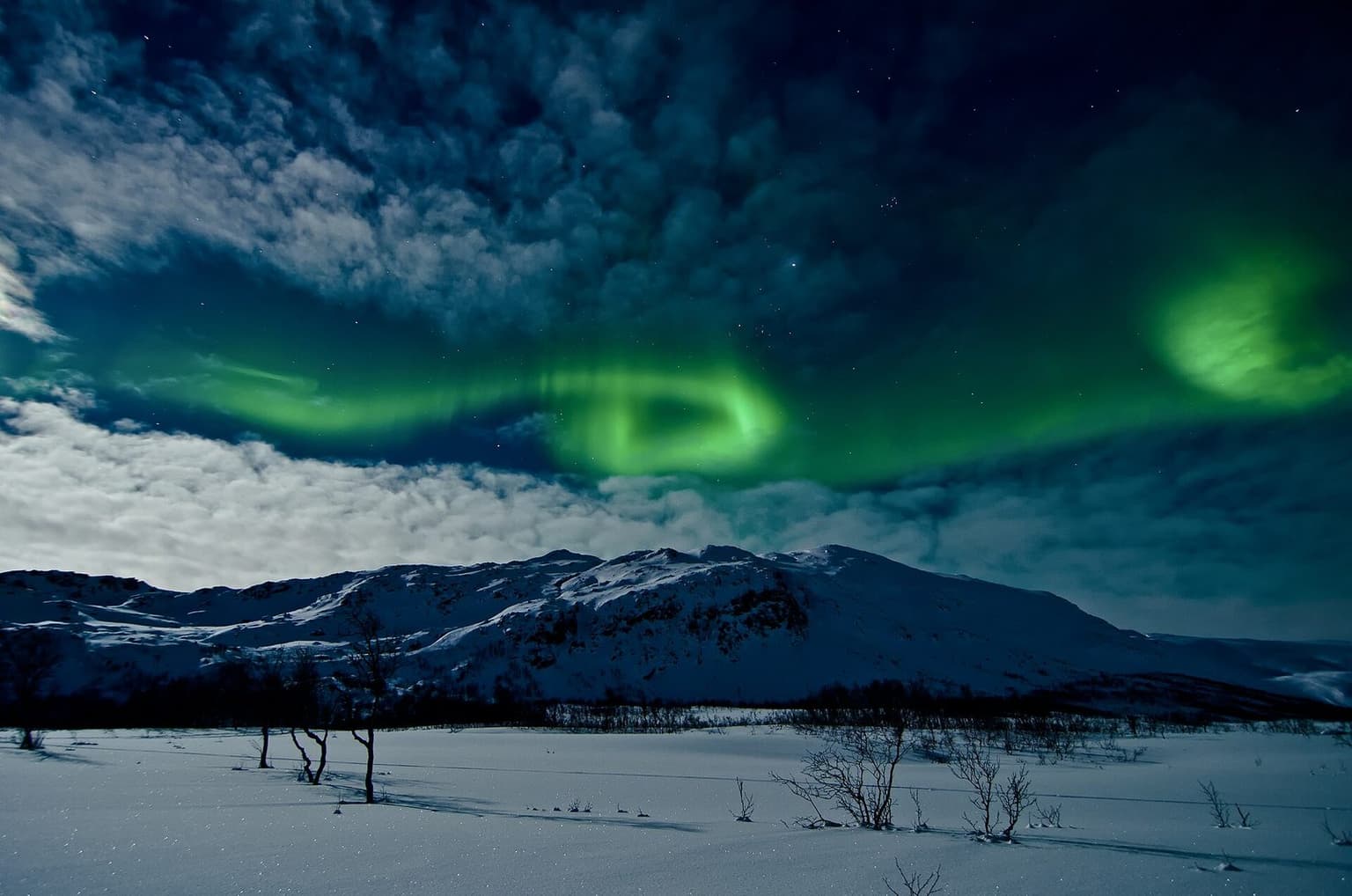
The auroral oval is a ring around the geomagnetic pole, and on an ordinary night of modest activity its band of best visibility runs across northern Scandinavia and through Iceland. Tromsø is inside the band's centre, which is why the lights there are often overhead and fill the sky. Rovaniemi and Reykjavík are towards its southern edge, which is why a quiet night there shows an arc low in the north and a strong night shows the whole sky. On strong nights the three are equal; on weak nights Tromsø wins.
Cloud
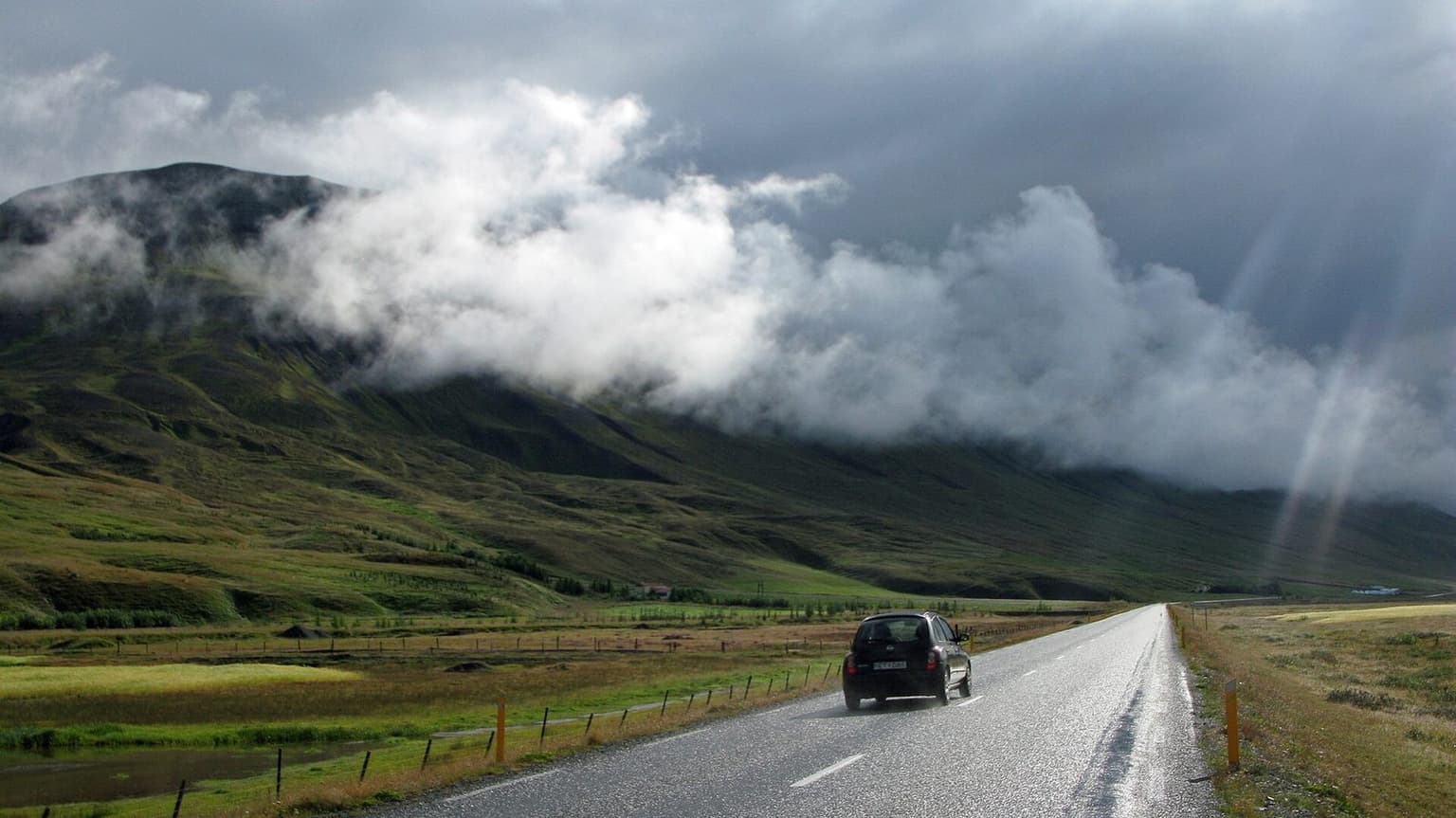
This is the comparison that matters and it is the one nobody can put a reliable number on for a given week. Iceland is a mountain in the North Atlantic storm track and its winter sky is more often cloudy than clear; Reykjavík's lights are seen on the nights between fronts, and the fronts come every two or three days. Finnish Lapland is inland under continental winter high pressure, cold, dry and clear far more often, which is why the resorts are there. Tromsø is on the coast and gets the coast's cloud, but the inland valleys an hour's drive away are often clear when the city is not; the Lapland route on this site uses that by basing at Kilpisjärvi and Tromsø on consecutive nights.
Access
Iceland wins without argument: direct flights from Britain, Ireland, the Continent and North America, a hire car in the terminal, Reykjavík forty minutes away. Rovaniemi has direct seasonal flights from a handful of cities and a Helsinki connection otherwise; Tromsø has a few direct winter flights and the Oslo connection. For a North American reader Iceland is one flight and Lapland is three.
When it is cloudy
Iceland's winter days are short but full: geothermal pools in every town, waterfalls that freeze on their edges, glacier ice caves from November to March, and a capital with museums and restaurants. The lights are the dessert. Lapland's day is sauna, huskies, reindeer, skiing and Sámi culture, all built for the season and priced as its high season. Tromsø has the cable car, the fjord boats, the Arctic cathedral, and a city that functions in the polar night. None of the three is boring on a cloudy day; Iceland is the one that is least about the lights.
Driving in winter
Iceland's winter driving is the most variable: Route 1 is open but closes in storms, and safetravel.is is the authority to obey. Finland's roads are ploughed, sanded and run at the winter speed limit; the Finnish Police's default limits are 50 in towns and 80 outside, with the main-road limits reduced in winter. Norway requires 3 mm winter tread in Troms from 16 October to 30 April. The Lapland route is 600 km in a week; the Iceland base is a series of day trips of 150 to 400 km; Tromsø is a base with short chases.
Verdict
Lapland for the lights, Iceland for the trip, Tromsø for the night of your life if the sky clears and the budget allows. The honest plan for a party that wants both is Iceland in September or March, when the dark is long enough, the roads are open and the days have enough light to see the country; and Lapland in February, when the cold has settled the sky.