The best month for the lights, with the formula
Dark hours (sun below −6°, computed) times the clear-sky fraction from Veðurstofa's 1991–2020 cloud record, for Reykjavík and Akureyri. December wins; it ignores the sun.
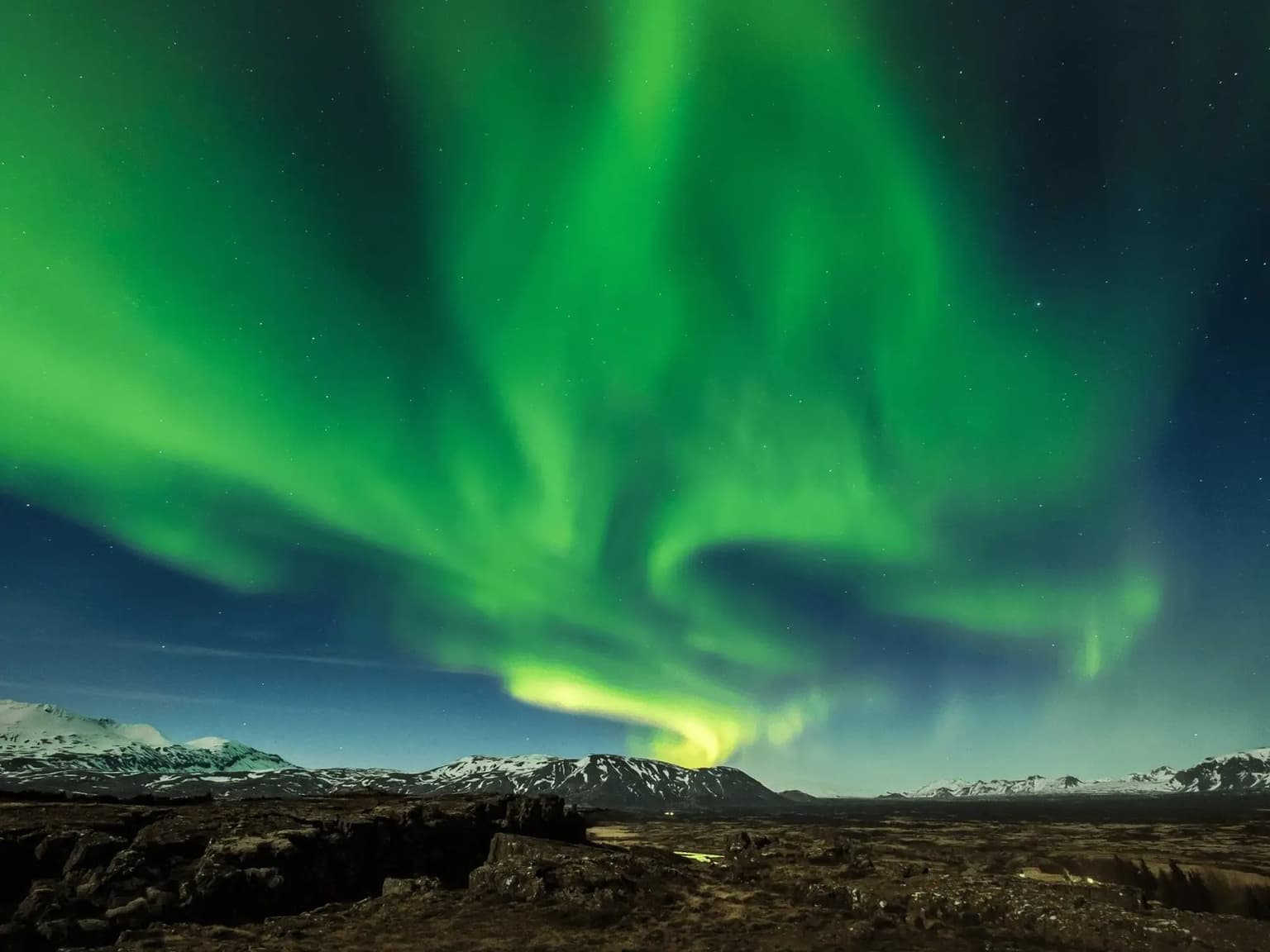
December, then November, then January, in both towns, and Reykjavík scores higher than Akureyri in every month that has a score. The formula is two numbers multiplied: the hours in the month when the sun is more than 6° below the horizon, computed, and the fraction of the sky that the station's thirty-year record says is not cloud. It is a planning score, not a forecast, and the last section is about what it cannot know.
The two inputs
Dark hours: for every day of 2027 the NOAA solar equations give civil dawn and civil dusk (zenith 96°) at Reykjavík, 64.15° N 21.94° W, and Akureyri, 65.68° N 18.13° W; the hours outside them are summed over the month. In June there are none in either town; in December Reykjavík has 529 and Akureyri 544.
Cloud: Veðurstofa Íslands publishes monthly values for its main stations back to 1949 as text tables (vedur.is, Meðaltalstöflur, "Mánaðargildi fyrir valdar stöðvar"), with a column nh for mean cloud cover in eighths. The 1991–2020 mean for each calendar month was computed here from those files for station 1, Reykjavík, and station 422, Akureyri; Veðurstofa's own 30-year table on the same page is for 1961–1990, so the newer normal is this site's arithmetic on the agency's numbers, not a figure the agency prints. The clear-sky fraction is 1 − nh ÷ 8.
Score = dark hours × clear fraction. It is the expected number of dark hours with a clear sky if cloud were spread evenly, which it is not, and the per-night column divides by the days in the month.
Reykjavík
| 2027 | dark h | cloud /8 | clear | score | per night |
|---|---|---|---|---|---|
| January | 503 | 5.95 | 0.26 | 129 | 4.2 |
| February | 384 | 5.91 | 0.26 | 100 | 3.6 |
| March | 329 | 5.88 | 0.27 | 87 | 2.8 |
| April | 210 | 5.74 | 0.28 | 59 | 2.0 |
| May | 60 | 5.73 | 0.28 | 17 | 0.5 |
| June | 0 | 5.98 | 0.25 | 0 | 0 |
| July | 14 | 6.09 | 0.24 | 3 | 0.1 |
| August | 169 | 5.96 | 0.26 | 43 | 1.4 |
| September | 280 | 6.01 | 0.25 | 70 | 2.3 |
| October | 391 | 5.71 | 0.29 | 112 | 3.6 |
| November | 464 | 5.70 | 0.29 | 134 | 4.5 |
| December | 529 | 5.78 | 0.28 | 147 | 4.7 |
Akureyri
| 2027 | dark h | cloud /8 | clear | score | per night |
|---|---|---|---|---|---|
| January | 515 | 6.24 | 0.22 | 113 | 3.6 |
| February | 388 | 6.20 | 0.23 | 88 | 3.1 |
| March | 327 | 6.18 | 0.23 | 74 | 2.4 |
| April | 197 | 6.02 | 0.25 | 49 | 1.6 |
| May | 33 | 6.02 | 0.25 | 8 | 0.3 |
| June | 0 | 5.81 | 0.27 | 0 | 0 |
| July | 1 | 6.27 | 0.22 | 0 | 0 |
| August | 146 | 6.18 | 0.23 | 33 | 1.1 |
| September | 274 | 6.14 | 0.23 | 64 | 2.1 |
| October | 393 | 6.32 | 0.21 | 83 | 2.7 |
| November | 473 | 6.19 | 0.23 | 107 | 3.6 |
| December | 544 | 6.25 | 0.22 | 119 | 3.8 |
Reading it
The darkness term does almost all the work: it runs from zero in June to 500-plus in December, while the cloud term barely moves, 0.24 to 0.29 in Reykjavík and 0.21 to 0.27 in Akureyri. So the ranking is the ranking of the long nights, with October and February as the shoulders at two-thirds to three-quarters of December's score. The cloud record does decide the towns: Akureyri's station reports more cloud than Reykjavík's in every month but June, by about 0.3 of an okta, enough to put it below the capital despite its longer nights. That is the opposite of the common claim that the north is the clearer side; the honest statement is only that the two stations' thirty-year means say so, and a station is a point.
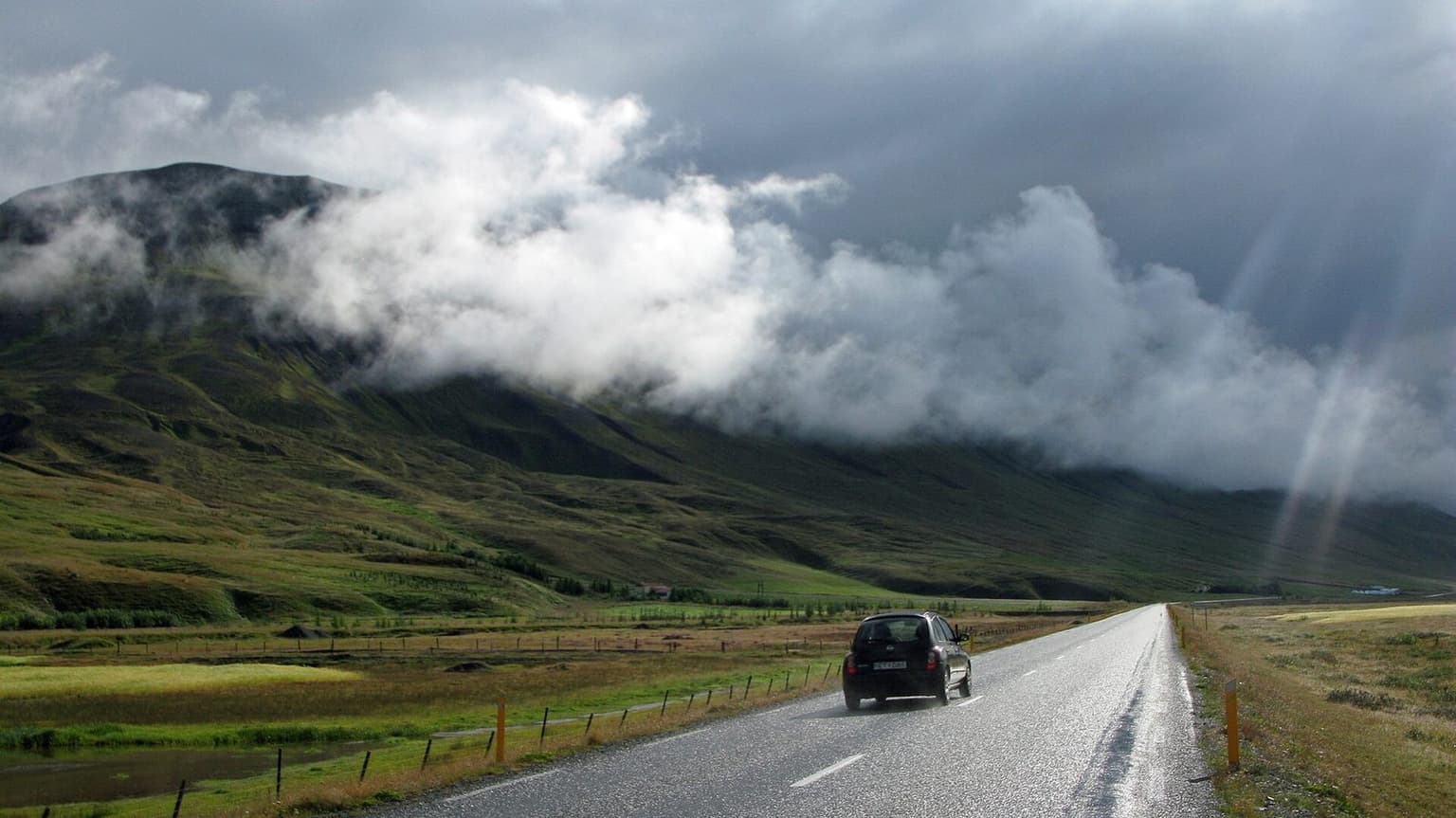
For a plan the per-night column is the usable one. Reykjavík in December averages 4.7 clear dark hours a night on this arithmetic, in October 3.6, in September 2.3; the North ledger (/journeys/iceland-north-diamond-circle-5-days) runs to October and the South Coast ledger runs all year, so a lights trip that is also a driving trip is October to February by this table, and October is the month where the roads are still the summer's roads.
What the score does not know
Solar activity, first and most. The lights need the sun to send something, and the score has no term for it: the Kp index on the night, the eleven-year cycle, a coronal hole that gives three good nights in a cloudy month. A cloudless night with nothing arriving scores well here and shows nothing. The Veðurstofa aurora forecast is the page for that, on the day.
The moon, which in the week of the full moon washes out the faint displays. The shape of cloud: a mean of 5.8 eighths can be five clear nights and twenty-five overcast ones or thirty evenings of broken cloud, and the two are not the same for a watcher. The hours you are awake: December's 529 dark hours include a great many at four in the morning. The horizon: Akureyri's station sits in a fjord, the lights sit low in the north, and a hill in the way is not in any table. And 1991–2020 is a mean of a climate that is moving. The score is the month to book, not the night to go out; for that, the sky on the evening is the only source.
Sources
- Veðurstofa Íslands, Meðaltalstöflur (monthly values for selected stations, column nh = mean cloud cover in eighths): https://www.vedur.is/vedur/vedurfar/medaltalstoflur/ and the files https://www.vedur.is/Medaltalstoflur-txt/Stod_001_Reykjavik.ManMedal.txt and https://www.vedur.is/Medaltalstoflur-txt/Stod_422_Akureyri.ManMedal.txt (1991–2020 monthly means computed here, 1 November 2026)
- NOAA Global Monitoring Laboratory, solar calculator equations (civil twilight at zenith 96°): https://gml.noaa.gov/grad/solcalc/calcdetails.html
- Dark hours computed here on 1 November 2026 for every day of 2027 with the site's daylight routine (lib/daylight.ts).
- Veðurstofa Íslands, aurora forecast (the page for the night itself): https://en.vedur.is/weather/forecasts/aurora/
The ledgers this post refers to
- North Iceland and the Diamond Circle in 5 days
Fly to Akureyri, drive Goðafoss, Mývatn, Dettifoss, Ásbyrgi and Húsavík and fly back: about 360 km and 5 hours of driving, with the 380 km road alternative costed.
5 days · Iceland357 km · 5 h drivingChecked 1 Nov 2026 - Iceland South Coast and Golden Circle in 5 days
Reykjavík base, a Golden Circle day, then two south-coast days to Jökulsárlón with nights in Vík and Kirkjubæjarklaustur: about 1,125 km and 14 hours of driving.
5 days · Iceland1,125 km · 14 h 10 drivingChecked 1 Nov 2026 - Lapland aurora week: Rovaniemi to Tromsø
Rovaniemi, Levi, Kilpisjärvi and the E8 to Tromsø in February: 600 km, nine hours driving, nights at 66 to 70°N. The route to weigh against Iceland for the lights.
7 days · Finland + Norway + Sweden600 km · 8 h 55 drivingChecked 1 Nov 2026